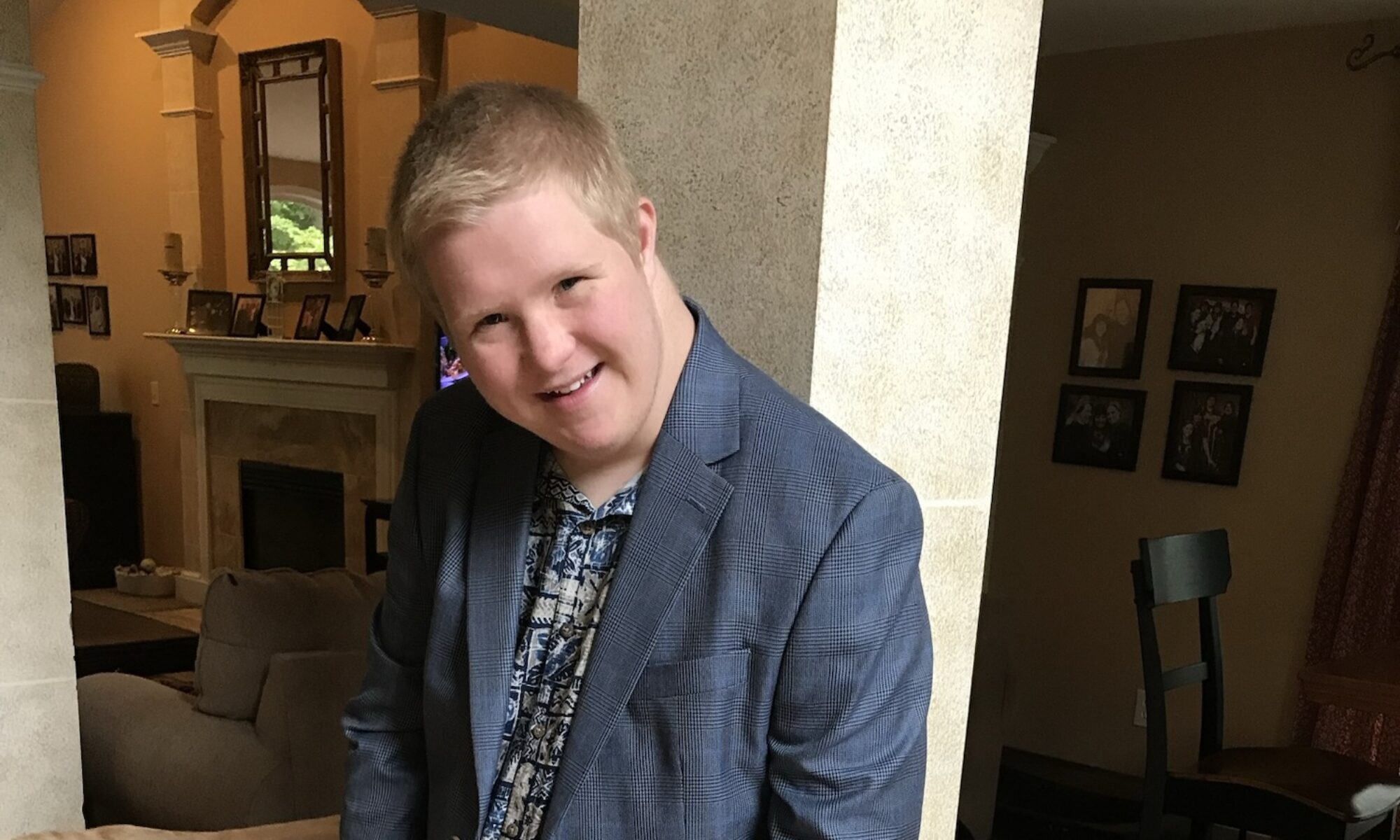
we all have gifts to share

[Welcome to our annual Guest Writer Series, a time in which we are intentional in listening to other voices. Know that AR may/may not agree with the perspective expressed. Know, too, that agreement is secondary to learning from others. Meet Guest Writer #4!]

* * * * *

Growing up I would hear older folks talking about someone being “odd-turned,” “peculiar,” “weird”, or “just not normal,” followed by “I just don’t know about that boy.” 

Their observations were correct. These individuals were not like other folks. Fortunately, there have always been people who appreciated differences. I remember the people who would not complain about those who were different but had an innate sense that they needed to be more insightful and were kind. I heard one lady say, “They are just who they are. God don’t make no junk. We need to look for their gifts.” That has always stuck with me.

The people I referenced would now be diagnosed with a neurodevelopment disorder. They were indeed different than those around them. Brains of those with neurodevelopment disorder process information differently. But that is only half the story. The other half story is about who they are as people. What gifts do these “abnormal processors” possess? They are more than their diagnosis especially since it is estimated that about 30% of the population has a neurodevelopment disorder.

As parents, teachers, doctors, neighbors, community members we have a responsibility to treat others like we want to be treated. When learning about others it is important for us to take responsibility for our reactions to others who may look or act in a manner different from the “normal” way of doing things. We have a responsibility to understand and to try to help them be included. This may involve teaching them boundaries or understanding their form or participation will be unique. Likewise, they have the responsibility of understanding they are different and sometimes may need to self-impose boundaries on themselves because when they perseverate or don’t understand how their intensity negatively affects others, things can be quite unpleasant for all. All may misunderstand the other.

We need to reflect on our own responses to those who are different. Sometimes  our reactions are cruel because we are not sure of what to do. For example, we may judge the parent of the child who is excessively hyper, has explosive tantrums, and/or mood swings by criticizing their parenting style. Sometimes they are also trying to figure it out. The are exhausted by the intensity of their child’s abnormal reaction to normal corrective measures and responses that just do not work with those who have neurodivergent processing. It is a process for all involved because it is ever present and the person does not “grow out of it.” We can all learn to adapt appropriately, but this take time and energy.

Families need support and understanding, not judgment. They, too, are learning how to best support and teach their child basic expectations. There is no one method. It takes a combination of counseling, behavior techniques, medication, and sometimes just a kind word. Too often we ask what is wrong with them because they make us uncomfortable instead of us asking what we can do to assist them. Often our outside perspective does not lend a fair assessment of others’ situations. 

As our understanding of brain function has increased so has our understanding of how to react to those who process differently. Neurodevelopment disorders like autism spectrum disorder (ASD), attention-deficit/hyperactivity disorder (ADHD), intellectual developmental disorders, communication and motor disorders sometimes are difficult for others to understand because they are not always visible. 

Perspectives develop differently because neurotransmitters fire differently. Neurodiversity is not a specific condition but a term that has become popular to better understand how those who were considered “abnormal.” During the 1990’s that there was a movement to start delving into this topic. Like individuals who have suffered great trauma, the research emphasized “why” the individual reacted to his or her environment and understanding how the differences can be strengths instead of just saying they were abnormal. The greater the understanding, the more inclusive we became as a society understanding their unique gifts. 

Those with extreme differences require extreme patience coupled with an understanding the individual did not choose to be this way. It is a condition of birth, not a condition of choice. When you parent or teach a young person with these unique characteristics, it takes strength to know each child’s tolerance and ability to adapt. It is exhausting at times especially when others do not understand. It takes intentional strategies to teach self-regulation so there becomes an understanding of what it means to work within the normal range of behaviors. Setting boundaries and teaching these coping skills are vital to all people integrating successfully into society.

Appreciating neurodivergent gifts is not easy. Sometimes the characteristics are so outstanding we cannot but hail their accomplishments. But we always must weigh the good and bad. The deed may be outside of appropriate limits. It is part of this journey. Neurodiversity gifts can outshine the “normal” limits in areas of enhanced problem solving, heightened creativity, unusual ability to remember information, attention to detail, increased analytical abilities, patten recognition, endurance, empathy, honesty, and loyalty.  

We have an obligation to understand others. We all have gifts to share.

Respectfully…

VEE

which one are you?

[Welcome to our annual Guest Writer Series, a time in which we are intentional in listening to other voices. Know that AR may/may not agree with the perspective expressed. Know, too, that agreement is secondary to learning from others. Meet Guest Writer #3!]

* * * * *

A VOLUNTEER — What is that?

The usual definition of that word refers to someone who works for no pay and responds to a need. I think of volunteers who do that for me. My little Minnesota hometown has a volunteer Fire Department. Any of us who have been in a hospital have been escorted to our destination by a volunteer, and if admitted, our room has been readied by a volunteer while another brings us water, flowers, mail, etc. And all of us are connected to a person who has been or is a volunteer for the military to serve our country. My point is that we are all the beneficiaries of volunteers.

A VOLUNTEER — Who does that?

I think of the volunteers who inspire us, who are role models. There is my friend Craig who plants, waters, weeds, and harvests at a community garden where all the food from it is given to the needy. I think of a lady who wore out her thumbs knitting, so she decided to learn brailing, and puts textbooks and recipes into brail for the vision impaired. I remember a mentor who was bedridden who became a prayer warrior saying she could do that from her bed. My own parents upon retirement volunteered at the local hospital, Mom as a seamstress, and Dad, a large man, an orderly who could easily lift and turn patients, and is needed could speak German to a less than cooperative patient. The love of my life, as part of a Habitat for Humanity crew, in sweaty heat, pounded nails to build homes for people he would never meet. 

A VOLUNTEER — Why not me?

So what about me? Do we volunteer, saying, “Yes, because it makes me feel good!” Well, I think that is a serendipity. I prefer to think of the Scriptural admonition, “To whom much is given much is required.” However, when we hear this, we define “much” by our bank account. But “much” has a far broader meaning. It can be a skill, a talent, our knowledge, our time. So, why volunteer?  Because we can. Because we should. Because it makes a difference. Because it is the right thing to do.

Many years ago these “becauses” were impressed upon by two different sources, both of which were affirmed for my “because.” One came from a grad school professor who was a marvelous teacher. He asked us to keep in mind that everyone carries around an imaginary bucket and that in every encounter we either put something into the bucket or we take something out of that bucket. Volunteers fill buckets.

And then there are the words of the poet who wrote:

“Isn’t it strange that princes and kings and clowns that caper in sawdust rings, 
and common folk like you and me are builders for eternity?
To each is given a bag of tools, a shapeless mass and a book of rules
And each must make ere time has flown a stumbling-block or a stepping-stone.”  

— R.S. Sharp

Volunteers build stepping-stones.

Respectfully…

DWL

a meaningless metric

[Welcome to our annual Guest Writer Series, a time in which we are intentional in listening to other voices. Know that AR may/may not agree with the perspective expressed. Know, too, that agreement is secondary to learning from others. Meet Guest Writer #2!]

* * * * *

Performance measurement is ubiquitous in the business world.  Companies understand that if an objective is quantified, monitored, and made visible, the objective is more likely to be accomplished, especially if incentives are tied to the metric.  Obviously, it is vital that the metric being incentivized is aligned with the desired objective.

The current thinking of some of our nation’s leaders is to focus on our trade deficit as an indicator of how well our economy is doing.  The term sounds scary.  It suggests that bad activity outweighs the good, so it is urgent that we fix it!  In reality, the trade deficit is a meaningless metric.

If a country exports more than it imports (in terms of whatever currency it uses), it is said to have a trade surplus.  If imports exceed exports, it has a trade deficit.  This terminology implies that net exporting is always and everywhere a positive.  That is simply not the case.

The United States has a trade deficit because we import more than we export.  In fact, we have the largest trade deficit in the world by far.  Do you know why we can afford to buy so much more than we sell?  BECAUSE WE ARE THE RICHEST COUNTRY ON EARTH!!  That’s why!  We would not want to trade places with anyone else.

Companies in other countries give us their goods and we give them dollars, which they can use to buy other items.  American companies sell products to those in other counties and in return receive dollars or foreign currency.  It is because we are so wealthy that we can import so much more than we export.

China has the largest trade surplus in the world.  China also has a much higher percentage of its population who are peasants.  Would you rather live in China or the USA?  That’s what I thought.

Let me try another approach…imagine there are three neighboring countries:  Agritopia, Industriland, and Servicestan.  The GDP (gross domestic product) of each country is $3 million.  In other words, their economies are exactly the same size.

Agritopia grows corn, wheat, and other farm products.  They sell $1 million worth of food to Industriland, $1 million to Servicestan, and consume $1 million themselves.

Industriland produces all sorts of manufactured goods.  $2 million of it is sold to Servicestan and $1 million is used domestically.

Servicestan does not make any goods, but they do excel at personal services.  Their citizens cut each other’s hair, give manicures, and treat skin to constitute a $3 million economy.  (They are much better groomed than their neighbors.)  Servicestan has no exports.

So, let’s calculate the trade balance for each county:

  • Agritopia – $2 million exports minus zero imports = $2 million trade surplus
  • Industriland – $2 million exports minus $1 million imports = $1 million trade surplus
  • Servicestan – zero exports minus $3 million imports = $3 million trade deficit

Oh my!  It looks like Servicestan is in trouble.  Maybe they should stop importing so much manufactured goods, but would that make them better off?  They could also reduce their trade deficit by discontinuing importing food, but then they would starve!

The fact is, there is nothing wrong with having a trade deficit.  In the example above, the economies of all three countries are equally strong.  I could even make the case that Servicestan is the best off, as they enjoy consuming the most and a greater variety of goods and services.  Regardless, the trade deficit figure is irrelevant.

Now, it is annoying when some countries place tariffs on goods we try to export.  That makes American producers worse off.  I would argue it’s best not to respond with reciprocal tariffs, thereby increasing the price of imports, because that makes American consumers worse off!  Ostensibly, our recent raising of tariffs was a bargaining tactic, so that we might make a deal to eliminate all tariffs.

However, that is not how the original “Liberation Day” tariff rates were calculated.  The individual rates were based on — you guessed it — our trade deficit with each country.  Allies like Israel who lowered their tariffs on imported goods from the U.S. to zero, were still assessed a 17% tariff.  Amongst the highest tariffs was Vietnam at 46%.  We enjoy inexpensive electronics, machinery, and clothing made in Vietnam.  Vietnam does not buy our goods at a commensurate level because, well, they’re relatively poor compared to us.

Perhaps calling the trade deficit meaningless goes too far.  The term does have some meaning.  It just doesn’t have the significance that some people associate with it.  Maybe we should just rename it to something like “net exports.”  Using the word ‘deficit’ makes “trade deficit” sound analogous to our federal “fiscal deficit,” which truly is unsustainable and will bankrupt us if it continues year after year.  To the contrary, our trade deficit could go on forever, and we would be just fine.  Meaningless or not, the trade deficit is harmless.

Respectfully…

FAH

doing it for Jack: how a tragic death is saving lives

Your worst fear as a parent has come true in a way you never imagined: Not only is your child dead, but his death is labeled a drug overdose. Few would blame you for trying to hide the truth, but Tom and Stephanie Quehl never considered it. Instead, they turned their son’s death into a call for action.

Jack was successful in high school and college, he’d traveled the world and had a large circle of friends. “He liked to gain knowledge, but he also loved sports,” Tom says. “He was funny. He started an Instagram called Number One Water Fan where he’d rate water. They were great…like he’d rate Skyline Chili’s water versus McDonald’s water.” 

At 23, Jack accepted his first job and moved from his hometown of Cincinnati to Baltimore. He had the world at his feet. How did he end up dead?

On September 18th, 2021, Jack and his friends met at a bar to watch football, and Jack and his friend Chris continued the evening at Jack’s place. The next day, their friends texted, then called. When Jack and Chris didn’t respond, they went to Jack’s house. They found Chris dead, and Jack was unresponsive. One called Stephanie.

“The only thing I remember him saying is, ‘I’m so sorry, Mrs. Quehl. I’m so sorry.’ Then I said, ‘Does he have a heartbeat?’ I don’t even know if I asked what happened…I thought okay, we’re going to go get to him… I don’t even know how we knew it was cocaine,” Stephanie says. 

After a night where Jack coded multiple times, the doctors said there was nothing more they could do. There was no hope. Tom and Stephanie let Jack go.

They questioned Jack’s friends after learning he had cocaine and fentanyl in his system—had he been an addict? His friends said no…but admitted Jack and many of them were casual drug users. “The friend group said that recreational use was around all the time,” Stephanie recalls. 

In any other era, casual drug use likely wouldn’t have killed Jack. But this is the era of fentanyl.

Fentanyl is as a lab-made opioid used to treat people following surgery or who suffer chronic pain, and legal, pharmaceutical fentanyl continues to be used this way. However, because it’s synthetic, fentanyl is relatively easy to make. It’s also extremely powerful—50 times stronger than heroin and 100 times more potent than morphine—

and highly addictive. Its manufacturing ease, potency, and addictive properties make it attractive to drug dealers, especially since it’s undetectable to the naked eye.

Drug dealers add fentanyl to street drugs and in some cases pass it off as something else completely. Current DEA testing shows that five out of ten fake prescription pills contain fentanyl and not the Xanax, Percocet or other medications they’re purported to be.

Imagining what happened to Jack and Chris that night is easy enough. Two guys, feeling young and invincible, decide to cap off the evening with a little cocaine. It’s nothing they and their peer group haven’t done before. But this time, although they don’t know it, the cocaine has been mixed with fentanyl. They die because fentanyl is so powerful that it only takes two milligrams, the equivalent of five to seven grains of salt, to kill. “I talked to my kids about not driving drunk and about not having unsafe sex,” Stephanie says. “I had no idea I should warn them about fentanyl.”

Word of Jack’s death spread quickly through Tom and Stephanie’s community, and they were open about it from the start. “I never really thought to hide it,” Tom says. At Jack’s funeral Mass, Tom spontaneously decided to take it head on. He stood before the packed church and spoke of their love for Jack. Then he said, “We know how Jack died. We know you know how Jack died.” Turning to the young people, Tom asked them to make better choices than Jack and added, “If you can’t do it for yourself, if you can’t do it for your friends or your family, do it for Jack.”

That “Do It for Jack” moment of inspiration became a rallying cry. “Stephanie said we need to do something. We need to start something and talk to people so no one else loses their Jack,” Tom remembers. 

Neither of them had any experience running a non-profit—Tom worked in IT and Stephanie was an elementary school teacher—but they pulled together family, friends, and neighbors and got to work. Tom and Stephanie did their first fentanyl awareness presentation in 2022. Since then, the Jack Quehl Foundation has talked to 10,000 students and parents, delivered 4 million media impressions, and testified on behalf of an Ohio bill to combat the fentanyl crisis.

It’s not easy. They’re up against young people who believe it won’t happen to them and parents who think Not my kid. Telling Jack’s story means reliving his loss every time. They feel frustration that his death is labeled an overdose. “Jack didn’t go out to die that night. Jack didn’t know fentanyl was in the cocaine,” Tom explains.  The Quehls say Jack, and everyone like him who died from fentanyl they never intended to take, were poisoned.

“Keeping going is a challenge,” Stephanie admits. But the positive reaction from students and adults at their talks bolsters them. Other parents reach out with stories of their children lost to fentanyl poisoning. Sharing knowledge in hopes of making a difference feels good. 

Tom and Stephanie want people to know that illegal fentanyl is an issue that impacts everyone. “Fentanyl’s not a red problem or a blue problem. You can be a Democrat, or a Republican, or a Libertarian and die,” Tom says. Stephanie adds, “There are no boundaries.”

The Jack Quehl Foundation’s message is simple: Any drug bought on the street or online could be contaminated with enough fentanyl to kill, no matter how authentic it looks. Talk to your kids, your co-workers, your friends, and spread the word. And if you’re faced with a choice to use a recreational drug or take an illegally sold “prescription” pill, stop. Make the lifesaving choice. Do it for Jack.

Respectfully…

Tracy Vonder Brink

Jack Quehl Foundation board member

For more information, please visit the Jack Quehl Foundation website at https://www.doitforjack.org/

time for our summer series!

Sincere admission #1: there are issues where my opinion is wrong.

Sincere admission #2: there are places in which my perspective is way off.

And sincere admission #3: there are issues and places where my opinion and perspective are wrong, way off, too narrow, misguided, missing info and more — and I don’t know it. I’m blissfully convinced I’m right even when I may unknowingly not be.

That reality necessitates that we ever employ humility, compassion and curiosity. Let me always be aware that there is so much I don’t know… and dare I say, don’t know that I don’t know.

Such is what makes it vital to listen to others. Let me say that differently. It’s vital to listen to a variety of others — people hailing from a wide range of varied social, ethnic, faith, political, educational, etc. backgrounds… people from different demographics… people with sundry stories. We often learn most when we lean into and listen to the story of one different than our own. Thank God for that beautifully insightful opportunity.

Hence, as delightfully said above, here we are.

It is time for one of the Intramuralist’s favorite practices, our annual Guest Writers Series! Over the course of the next few weeks, you will hear from an articulate group of communicators from all sorts of backgrounds. They are ages 20-something to 80-something. They represent various ethnicities, genders and political leanings. They have advanced degrees and no degrees. And they are passionate about a plethora of manifold matters. You will hear about volunteerism, accepting others, and lies we commonly believe. You’ll hear about tariffs, birds and a little bit of baseball. You’ll also hear the journey of one set of parents, for whom the tragic death of their son is leading to so much more. So many stories… as author/researcher Brené Brown likes to say, “Maybe stories are data with soul.” You will get a glimpse into the soul of another.

But let me again share what each of these gifted communicators most have in common…

They desire to share with you in a way — whether in agreement or not — that is respectful… that encourages you… that makes you think. They do not believe in insult. And they are wise enough to know that agreement is secondary to how you treat other people. Only one is a manifestation of wisdom.

In the meantime, as is my annual practice, I will take a bit of a respite. I believe in intentional rest, and I’m grateful that while I have come a little late to that understanding in life, I find the routine practice to be physically, emotionally and spiritually necessary and refreshing. 

I will thus utilize this time of rest to engage in a season of gratitude, travel and personal reflection. I’m eager to think and dream and pray and reflect… What should we talk about this fall? … What perspectives am I not all that humble about? … Where are my perspectives incomplete or inaccurate — and I’ve been unwilling to see them? … Good stuff, friends… indeed, good stuff.

For the record, please know that the opinions expressed are not necessarily those of the Intramuralist. I may agree. I may not. But again, agreement is always secondary to listening well… loving my neighbor well, too.

We learn from one another. We learn from diverse voices. We learn from the stories of others.

Time for this year’s Guest Writers Series. I can’t wait…

Respectfully…

AR

what’s happening in California and why

One of the challenges with events that are prime to provoke ample emotion is that it’s easy to rank aspects of what is/is not occurring; it’s instinctive to prioritize one angle over another, diminishing or dismissing what doesn’t fit with any predisposed belief or past experience.

That’s why where we get our news from matters. If there’s anything we’ve learned from the two most recent presidencies, news sources cover/don’t cover events in a way that fits with what they want us to believe. They don’t cover all things equally nor accurately.

What’s also relevant is both the media and the masses (i.e. us) often see all or nothing — a black/white approach suggesting all is clear in regard to what is right and what is wrong. We forget how two competing circumstances, narratives or emotions in need of attention and solution can exist at the exact same time. Current events are not so nice and neat.

Many are watching what’s taking place in California, in the current friction between law-enforcement and protestors — and resulting friction between state and federal authorities. The bottom line issue is with illegal/undocumented immigration. Allow us to objectively elaborate.

There are persons in this country who are not here legally. Different descriptions are used by different people. Some call them “illegal immigrants.” Some people call them “undocumented persons,” and there are various, creative combinations. The reality is that both “illegal” and “undocumented” are accurate, as the terms describe persons who entered this country by means other than what’s consistent with stated law. 

For years, legal immigration has been a challenge for our legislators to solve; it’s not so nice and neat. The reality is that embedded within the illegal/undocumented are so-called good people trying to come here for a better way of life; there are also people coming with evil intent, trying to destroy our way of life. Additionally, in this group, there are people earnestly wanting to work hard, earn a solid wage, and improve their family’s future; there are also people coming who indeed want to improve their family’s future but instead via a publicly assisted welfare state. True, too, is that there are parents and children — parents who entered illegally with children who were born here, making them U.S. citizens. All of the above are in the same boat. So who and what do we prioritize? Who and what do we ignore? And why?

Both our legislative and executive branches have struggled with this issue for decades, evident by the number of politicians who have contradicted their previous prioritizations. But I will give them some credit; it’s difficult to solve an issue when one size so clearly doesn’t fit all. So many angles must be considered in order to solve this issue wisely.

What’s happening in Los Angeles is thus hard to react to. The protests began as a reaction to U.S. Immigration and Customs Enforcement (ICE) conducting a series of immigration sweeps last Friday. While there has been significant violence, it is by no means a war zone, has been limited in scope and size, but now extends past downtown. Note once more the problem with where we get our news, as stated by Austyn Jeffs of the more trusted The Free Press: “Thousands of protesters gathered in Los Angeles on Sunday to protest immigration raids, and news coverage of the protests painted two different pictures. On the right, media said the protesters were organized far-left antifa members and Mexican nationalists. On the left, the protesters were supposedly peaceful.” Friends, neither is an accurate representation. The media makes things worse.

When I try to find a wise angle to a complicated problem, I often go to what is one of the most poignant interactions I’ve ever known to be true. Even if you are not a Christ follower, let me suggest we each consider, as I think this makes so much sense, and I believe it describes the tension now.

Over the course of the life of Jesus, there was an incident where a woman is caught in adultery; adultery violated both legal and religious law. The woman is brought before a public crowd, with a venomous public adamant in stoning her; it’s a just consequence for an illegal act. First, though, comes Jesus… initially quiet — maybe making some observations, taking all things in. Then he speaks. He starts by questioning the crowd — maybe even chastising them. He rebukes them for their lack of compassion and humility. Losing all self-grandeur, the crowd slowly, one-by-one, walks away. Jesus then moves toward the woman, speaking gently but firmly, mincing no words. She did something wrong; he adjures her to stop. And he and she both acknowledge and agree. They call the kettle “black,” the spade a “spade” or whatever idiom we wish to insert. Jesus acknowledges the wrongdoing and has compassion at the exact same time.

So much of the problem with current society is that we struggle with holding those two things. Sometimes our compassion blinds us to what’s right and wrong. And sometimes our understanding of right and wrong obscures our compassion.

Respectfully…

AR

the fine art of not agreeing

I try not to be one who refuses to learn and grow and “get with the program” with new technology, so-to-speak. Hence, I’m trying to be a wise and witty user of ChatGPT. 

Consistent with the values of our blog, I asked AI to write a creative poem about disagreement — how it’s ok and can be used to our benefit if we do it well. Granted, if we do it poorly, it can be damaging. Even the intelligent fall prey to such. 

The reality is that respect is not dependent on agreement. In fact, I often respect most those who sit beside us, ask good questions, and actively, sincerely seek to understand as opposed to simply share where another is wrong.

We have so much to learn. We also have places where we can all be more respectful. Here’s to the fine art of not agreeing…

Oh blessed clash of minds and wills,
Where coffee cools and tempers spill,
Where “I see it differently” begins
The noble sport where no one
wins.

For must we always nod and grin,
Pretend that every view’s a twin?
That every take is just as grand,
As if we all were clones on hand?

Disagreement’s not some plague—
It’s jazz! A dance! A rich mosaic!
If done with grace (and not with spite),
It sharpens thought and sheds new light.

But do it poorly—my, oh my—
The air grows thick, the sparks can fly.
One snide remark, one mocking tone,
And now you’re fighting on your own.

You stomp, you scoff, you roll your eyes,
(How dare they not idealize
Your every word, your perfect view!)
But hey—perhaps the flaw’s with
you.

For those who dodge dissent like plague,
Who only nod, or mutter vague
Approvals just to keep things smooth,
Might lose the edge that helps us move.

Disagreement isn’t doom or war—
It’s just two minds with something more
To learn, to test, to push, to prove,
A kind of dance to help us move.

So speak your mind, but don’t be cruel,
And listen too—it’s half the rule.
If we can clash and still be kind,
We might just grow a wiser mind.

So disagree! But do it well.
Don’t turn a room into a hell.
It’s not a sin to not align—
Just don’t be a jerk
when you opine.

Here’s to disagreement. May it be an unexpected, insightful strength to a continuous more…

Respectfully…

AR

incentivizing courage

None need a Ph.D to discern the division planted in present-day culture. While there’s temptation to hold specific individuals responsible for the current contempt, many suggest the onset of the heightened discord can be traced to the late 70’s, when local D.C. establishments became more exclusively Democratic or Republican. Our leaders stopped socializing with one another. It’s amazing what happens when people stop hanging out with diverse others; they stop seeing the beauty and potential wisdom in the one who thinks differently than they. Such creates an environment for the polarizing individuals to become more prominent.

This environment then creates an allure of the binary choice — that somehow one person or party is all good and the other is all evil — or — because one is all evil, the other is at least good enough. And just like that we fall into this trap that creates a sort of blind conformity or collective tunnel vision. It’s where people fall in line and echo the voices of the herd around them, as opposed to saying what needs to be said or doing what needs to be done.

I wonder how this happens within Pres. Trump’s administration. To suggest Trump can be erratic in either speech or behavior is not an understatement. There is valid question, as recently discussed here, as to whether his desired end always justifies the means. If there was a constitutional issue or law broken, would those most adjacent to his decision-making, who can see it best, speak up? Or would they simply fall in line? If not, would those in closer proximity to the President be threatened with loss of access, influence or future opportunity?

I wonder: where is the courage?

No doubt that’s what happened with Pres. Biden. As we hear more of the cringe-worthy reporting from Jake Tapper and Alex Thompson on the interview circuit after the release of “Original Sin,” sharing numerous reports of how Biden’s inner circle intentionally covered up his cognitive decline, they speak of the numerous people who fell in line, choosing to either say nothing, see nothing, or gaslight instead. It wasn’t a question of whether the President should be President again but rather, whether he should have been President now.

Again we ask: where was the courage?

The division hurts us in that way. People fall in line, staying loyal to their so-called team, but oft adhering to questionable ethics along the way. As we ponder how to solve, my strong sense is we need to collectively incentivize courage.

We have challenges in current culture that we need people to be able to say out loud and soon solve. But when leaders currently attempt to do so, the other party pounces. In my opinion, this isn’t simply unfortunate; it is foolish. They are killing courage.

Let us acknowledge one of the biggest places we need courageous problem-solvers…

Allow me to introduce Jim Millstein, a former senior U.S. Treasury official who led the restructuring of major financial institutions like AIG after the 2008 financial crisis, one who was on the frontlines of combating the worst economic calamity since the Great Depression. Hence, his take on America’s national debt is significant. It’s also sobering. Millstein believes America could face a massive crisis in the next few years if Washington does not act.  

As he shared last week, “The United States is running a $2 trillion deficit this year. Over $1 trillion of that will go just to interest payments, now the second-largest category of federal spending after Social Security.

That interest burden is not going away. It is getting worse. Over the next twelve months, the Treasury will have to refinance $10 trillion in debt. If interest rates keep rising, we are headed into what Millstein calls a debt spiral, a vicious cycle of higher borrowing and higher interest payments with no end in sight.

This is not a theoretical problem. If we fail to act, Americans will see the consequences everywhere: higher mortgage rates, rising costs on car loans, and an economy hobbled by political paralysis.”

That’s the problem our division has created. This is not a Trump problem or a Biden problem or a Republican problem or a Democrat problem. This is an American problem, created by a lack of courage.

We need courageous leaders from both the left and the right to engage in far more respectful, kind conversations on this and multiple other topics… How do we fix? How do we move forward?… Note that neither party has made any significant progress on decreasing our debt since 2001. That means that absolutely neither party is guiltless nor “more wrong.”

That’s the problem with division; it encourages those nearest the decision-makers to fall in line and not speak up. Thus, for the good of our country, we ask: how can we incentivize courage?

Respectfully…

AR

ways to come together

While it’s something we strive for, it doesn’t always happen here. Sometimes we’re not great at it. But our desire is to provide ways for people to come together.

I’m not a believer that agreement and coming together are mutually exclusive. It’s the difference between encouraging unity or uniformity. Unity is a longtime, consistent component of wisdom within relationship. Unity means we emphasize a sense of togetherness and harmony, even with differences. Uniformity emphasizes sameness. In a world as big as ours, sameness simply doesn’t make sense to me.

Hence, there’s one development this weekend that grabbed my immediate attention that I thought could indeed be a place where we more easily come together because of a sensitivity to the story. If we make what’s most important, most important, there is great potential for unity. Let’s talk about DJ Daniel.

DJ, also known as Devarjaye, is the 13 year old boy singled out in the nation’s most recent State of the Union address, in which his father Theodis hoisted him up, and the young boy was sworn in as an official agent of the United States Secret Service. DJ dreams of becoming a  police officer, so as the moment was happening, there was first a look of shock; his eyes were huge. And then in perhaps the most beautiful, unscripted moment, DJ spontaneously hugs the Service Director. No politics mattered to me at the moment. That kid just had the night of his life.

Part of DJ’s story is that he had cancer. In 2018, he was diagnosed with brain cancer and given 5 months to live; it was thought to be incurable. That’s much of what made the March moment so meaningful.

A few days ago, DJ’s dad announced that three new tumors have been discovered. His prognosis is not good. Said Theodis, “It’s rough, there isn’t a class that can teach you how to deal with it. You’re hearing that your child has a nasty disease.”

No class. Just life. And learning how to navigate the hard.

Heartbreaking, indeed.

DJ has undergone 13 brain surgeries in his short-lived 13 years. He has what’s termed anaplastic ependymoma. While there is always hope, there is no current known cure.

I’m fascinated, though, with the young man’s response in the wake of the heartache.

Said DJ previously, “I’m gonna keep on going until my gas tank runs out. And that’s when God calls you home. You never know when God’s gonna call you home.”

And his message to other kids with cancer: “Have faith, believe in God, and listen to your parents.”

There is something inside of DJ that I want to know more. There’s just this combination of resilience, faith and fight that is so good and right and true. He possesses a positivity within him that he would have every understandable right to let go… to be angry, distressed and emotionally paralyzed.

And yet he’s not.

Oft these days it seems we speak of a world “short of heroes,” a society in which we long for leaders and individuals who embody courage, selflessness, and the ability to inspire positive change.

Maybe DJ is an unlikely hero. He’s only 13. And yet, he embodies all of the above.

Godspeed, DJ Daniel. We wish you well. We pray for you and your family, too. Thank you for your contagious, authentic example. Thank you for helping us keep what’s most important, most important.

Blessings…

AR

what’s happening with Harvard?

With the class of 2025 graduating tomorrow, there seems to be significantly more attention than typical this spring at Harvard… albeit not on the actual commencement in Cambridge. Allow us to respectfully unpack the issue…

As the nation witnessed, between 2023 and 2024, antisemitic incidents on college campuses increased by 84%. According to CNN, most of these incidents were classified as harassment and second most were acts of vandalism toward Jewish people or people perceived to be Jewish. Many of these incidents occurred between mid-April and mid-May 2024 in response to the Israel-Hamas war in Gaza.

Two months after the Israel-Hamas war began, three Ivy League college presidents testified before Congress in regard to the protests. One was from Harvard, although none of the three seemed to fare very well; granted, it was at the height of the intensity on the issue. Yet when the then-president of Harvard was asked whether “calling for the genocide of Jews” would violate Harvard’s rules against bullying and harassment, Claudine Gay said, “It can be, depending on the context.” 

Gay would later apologize, but the damage was done, and such became one large factor that ultimately led to her resignation. There was simply great thought across the country that the nation’s oldest university wasn’t taking antisemitism seriously enough. 

Enter Pres. Trump, not one to seemingly shy away from a fight, who upon return to the Oval Office, called for a crackdown on antisemitism, even signing an executive order nine days in, directing tougher enforcement.

Because there is absolutely no place for antisemitism, invoking sterner measures is understandable. What gives me pause, however, is I’m not convinced the end justifies the means — something I oft question with this administration and more. Jonah Goldberg, editor-in-chief of The Dispatch, a conservative but not a Trump supporter, said it well, in my opinion:

“Perhaps the most frustrating thing about being a conservative critic of Trumpism is that you often start by agreeing with Trumpworld about ends while disagreeing about means.

This pleases nobody. The left, broadly speaking, considers the ends as illegitimate as the means, and the pro-Trump right thinks that if you’re against the means you really don’t desire the ends. I’m against the abuse of power, even for my own ‘side.’

…  consider Harvard. If you read its own report on antisemitism at the university, it’s hard to disagree with many of the administration’s criticisms. Harvard has been intolerant of internal dissent, and its educational philosophy has been absurdly left-wing. For instance, a mandatory class for students at the Harvard Graduate School of Education deployed a grotesque chart titled ‘The Pyramid of White Supremacy’ equating free trade agreements with ‘slavery’ and ‘colorblindness’ with ‘racial profiling.’ (See Page 150 of the antisemitism report; the graphic is no longer in use.) It suggests that the Anti-Defamation League is engaging in ‘coded’ rhetoric for ‘genocide.’ Meanwhile, the Harvard Law Review seems to be practicing flat-out racial discrimination.

But as Charles Lane of The Free Press recently put it, ‘Harvard had it coming. That doesn’t mean Trump is right.’ The Trump administration has frozen funding and ended new research grants to Harvard unless it adopts recommended reforms, and the president wants to revoke the school’s tax-exempt status. These are draconian ‘remedies,’ raising a host of different ethical, prudential, legal, policy and constitutional issues. Suffice it to say, I think defunding cancer research to own the [liberals] seems like overkill. Removing Harvard’s tax-exempt status is probably illegal. But even if it’s not, it’s insane to do it via executive order and would set a precedent conservatives will rue.”

Harvard has rejected the administration’s reforms and demands; the situation thus continues to  escalate. “Team Trump? Or Team Harvard?” coined The Free Press. To call it messy is an understatement, with errors in wisdom on all sides. The Trump admin is now attempting to bar the school from enrolling international students, a demographic that accounts for 27% of their student population. A judge responded by blocking the move.

Again, it’s messy. As Oliver Wiseman writes for The Free Press, “How did institutions come to stray so far from the values they were founded on? How much, in a liberal democracy, should the federal government interfere to try to fix those institutions? And is the current president actually interested in repairing what is broken—or just attacking his perceived enemies?”

Those are excellent questions. I wish we could tell.

I also wish we were better at solving problems. Too much gets in the way… even at commencement.

Respectfully…

AR