
a radical, messy “a-ha”

I had a bit of an “a-ha” this week. I think I finally figured it out. 

In recent years, the reasonable among us have sensed an increasingly significant problem with the polarized ends. Respect has wavered; the rancor has intensified. The far left/far right no longer see any good in the other.

“How did America get this way?” chided Elizabeth Kolbert in The New Yorker. “Partisans have a simple answer: the other side has gone nuts!” 

(Insert LOL here…)

And just like that the polarized ends point the finger at someone other than self. Partisans do it. Administrations do it. Unfortunately, the elementary prudence repeatedly conveyed by our parents that “you-own-up-to-what-you-do” hasn’t filtered up to way too many partisans and politicians. It’s simply easier to blame someone else. Them.

A frequent Intramuralist conversation has focused on the damage of the adult finger pointing. But my “a-ha” this week more centered on the why…

Why is there a problem with the polarized?

As much as I cringe actually admitting such — not wanting to fuel either of the opposites’s heedless, hell-bent fire (aka points of view) — most likely the far left and far right may each have a sensible approach on some, maybe very few things. For let’s admit: even a stopped clock is right twice a day (as I was also oft reminded in elementary school).

Both the far left/far right make excuses for protests/protestors they like. Both make excuses for gerrymandering that works in their favor. Both make excuses for borrowing and spending massive amounts of money. Both, in other words, make excuses.

Ok. Got it. I hear you; you’ve heard this before here. But what’s new to me this week is why this matters. I mean, it’s ok to be passionate. It’s ok to have strong feelings. There are many convictions I, also, strongly adhere to.

But when we only adhere to a far left or far right perspective — and believe only the others have gone nuts — why is that a problem? What’s the value in the middle?

We’ve heard some insightful descriptions of that middle… “the radical middle”… “the messy middle”… In truth it isn’t all that radical, and it doesn’t need to be so messy. I think it’s just that the extremes are really, really loud, and they’d like to convince us there is no wisdom or reason in hanging out in someplace other than a polarized, isolated camp. They’d like to convince us that the other side is so dangerous… and they, of course, are the only solution to save us from the ills and evils of the other.

They, my friends, entirely miss what the middle provides.

Hear me here…

The middle is where shared experience takes place.

(Feel free to read that again.)

From author, renowned business strategist and executive trainer, Bryan Kramer: “A shared experience is exactly what it sounds like: seeing, hearing, or doing the same thing as someone else. Although it’s a simple concept, shared experiences have a deep impact on human socialization because they enhance each person’s individual experience… Shared experiences are powerful because they bring people together…”

The middle, friends, is where we learn about other people. And not just a select, isolated few.

On the fringe — on those polarized opposites where we justify the protests/protestors, gerrymandering, massive spending and the like — they aren’t learning about most of the people; with all due respect, they’re only learning about people who already think like them.

I know this isn’t easy. It’d be far easier to camp in a polarized place; it’s comfortable there. I no longer have to consider whose wants and needs I’m ignoring when I remained firmly entrenched on a polarized fringe. And no doubt, the pandemic exasperated the entire scenario, as our isolation only increased. But that doesn’t make it wise.

Shared experience is wise. It expands our thinking. It makes us aware of the understandable differences of opinion — even passionate differences. But while differences of opinion are society’s reality, division — intentional polarization and the thinking of others as nuts — is a choice. That choice is a lot harder make in the middle.

Respectfully…

AR
the abortion debate…

Many moments I have ventured into this topic. Join me, if you will. But allow me to initially provide a brief bit of both caution and ground rules…

First, all persons with all perspectives are to be treated with unwavering respect. Second, we encourage the generous asking of questions for that which we don’t understand. And third, if you’ve already decided all that you believe and thus have no room to grow and merely wish to find new venues to voice your already-fully-established opinion, that’s fine; but this probably isn’t the place for you. One of my deepest convictions is that I will always have more to learn. I never want to be that place of so-called rocky soil where words of truth can’t permeate my stoic, hardened exterior. Such isn’t attractive. Nor healthy or good.

So let’s start with a simple question: what has contributed to the molding of your opinion on the issue of abortion?

Your experience?

The experience of another?

Your faith?

What you believe to be moral?

Unquestionably, this may be one of the hardest current issues for people to dialogue about. Respectfully or not. Many believe they are defending a God-given right. Many, too, believe they are acting in defense of God.  

Isn’t that what makes conversation challenging? We start from an immediate defensive position. I contend that such a posture is both relationally and societally damaging.

Damaging, too, are the loudest voices on each side of this issue. As written by Caitlin Flanagan in a thoughtful piece entitled “The Dishonesty of the Abortion Debate” in the December of 2019 issue of The Atlantic: “The loudest advocates on both sides are terrible representatives for their cause. When women are urged to ‘shout your abortion,’ and when abortion becomes the subject of stand-up comedy routines, the attitude toward abortion seems ghoulish. Who could possibly be proud that they see no humanity at all in the images that science has made so painfully clear? When anti-abortion advocates speak in the most graphic terms about women ‘sucking babies out of the womb,’ they show themselves without mercy. They are not considering the extremely human, complex, and often heartbreaking reasons behind women’s private decisions.”

Those loud voices aren’t changing hearts, minds, nor behavior. Hence, when we scream or utilize the oft imperious mic drop with others, we simply cause others to conclude they don’t want to be like us. Therefore, to have this conversation, let’s cast away the defensiveness…

Roe v. Wade has been the law of the land since 1973. The ruling stated that Texas statutes criminalizing abortion violated a woman’s constitutional right of privacy in most cases. The high court found such to be implicit in the liberty guarantee of the due process clause of the 14th Amendment (“…nor shall any state deprive any person of life, liberty, or property, without due process of law”). While ruling that government could not prohibit abortions during the first trimester for any reason, it permitted state regulation thereafter. Several in the legal community questioned the soundness of the original ruling. The Court then revisited and modified the ruling in 1992 in Planned Parenthood v. Casey. That decision removed the first trimester requirement. Many have since advocated and legalized the right to abort up to the moment of birth. 

Also in 1992, as previously noted here, Pres. Bill Clinton intentionally worked to find common ground language, saying he desired abortion to be “safe, legal, and rare.” Such allowed him, as Flanagan stated in a separate piece, to “bring together a range of abortion supporters under a now-abandoned umbrella.” Those words were expunged from the plank of the Democratic Party 10 years ago. So here’s an honest question: do we still believe in “rare”?

No doubt that’s part of the current challenge. What was once understandably, respectfully controversial — with women and men of good conscience on both sides of the issue — has now become radical. It is one thing to advocate for the right for women’s reproductive health, where we may disagree on the right to abort when we juxtapose women’s rights vs. another life or potential life. It’s a far other, sobering thing to advocate for the ceasing of a baby’s beating heart right up unto the moments before birth.

I sincerely, respectfully wonder if we would be where we are now if this societal approach would not have become so radicalized. Polling shows that most support Roe. Polling also shows that most oppose abortion after the first trimester. That is the current quandary.

And so I respectfully ask… wanting to promote respectful dialogue…

Where should the limit on abortion be? At what point is it no longer a choice?

At what point does the unborn child have a similar, fundamental right to live?

What is moral?

What is both God-given and in defense of God?

And again, how would you define “rare”?

I’ll say it again: this isn’t easy. And I hate that so many refuse to even dialogue; my sense is they/we/me each have a bit of rocky soil in our hearts. Yes, I’m watching developments regarding the current publicized Supreme Court draft, which speaks of overturning Roe — not making abortion illegal — but rather, returning the decision to the states. Regardless of where the decision lands, I believe there to be wiser questions for us to individually both boldly ask and humbly answer.

But let’s again be honest. A wise discussion will only ensue if embedded defensiveness is cast away. Join me, if you will…

Respectfully…

AR

the original post, leak, Court & more wisdom

With a full week ahead, I penned this week’s midweek post a little earlier than usual. It began like this…

“With the inflating situations abroad in Ukraine and at home in the economy, the Intramuralist continues to actively search for what is good and right and true. As a society, we no doubt struggle with this at times — especially when we’re passionate about an issue. There’s just too much finger pointing. Too much justified denigration. Too much assumption of motive in the perspective that’s different.

Allow me, no less, one more ‘too much’…

There’s too much lack of awareness of whom the enemy really is…”

I then continued by sharing news of the gathering last week of 22 women in Washington. Maine Republican Susan Collins and California Democrat Dianne Feinstein gathered 20 of their Senate colleagues to dinner. The ladies sat around a large table. Politics wasn’t discussed. It was an evening intent on relationship.

Said some of the attenders…

“It’s the biggest group of women I’ve ever had dinner with since I’ve been here,” said Sen. Feinstein.

“I’ve been here a while, and it’s just nice to relax and have conversations with friends,” said Sen. Deb Fischer, the Republican from Nebraska.

“It was lovely. We enjoy each other’s company, and then we get to know each other as women first, not really as senators,” offered Sen. Kirsten Gillibrand, the Democrat from New York.

I then quoted No Labels, the admirable, growing organization that is actively promoting an emphasis on respect and bipartisanship…

“This sort of thing shouldn’t be shocking – or rare…”

No Labels continued: “… Sadly, as the two parties move ever more toward the extremes, and as social media noise and nonsense overwhelm rational discourse, we’re losing those bonds that cross party lines – and more and more Americans find themselves politically homeless.”

And I wrapped up the post by focusing on the noise and nonsense that actually overwhelms rational discourse… on the right. And on the left.

Including — I respectfully submit — on society’s most passionate issues…

We lack awareness of whom the so-called enemy actually is.

Friends, in the wake of the shocking Supreme Court leak of a draft opinion on the constitutional right to abortion, we’ve seen a lot of denigration — a lot of attacking… a lot of people assuming the worst about another…

“You don’t really care about babies!… You don’t care about women!… You don’t care about a [insert ‘woman’s’ or ‘baby’s’ here] life!… You don’t care!” 

And the list goes on (much of which is inconsistent in a blog modeling respectful dialogue).

I get it. But when we do that… when we scream and shout, demonize and denigrate, we have inerrantly concluded the politically different are our enemy.

I think of the women at that table last week. No way they all agree on pro-life, pro-choice, or pro-you-name-it. No way they all agree on the upcoming Supreme Court decision; they might even be passionate. But they have also gleaned the wisdom in being intent on developing relationship. That shouldn’t be shocking nor rare.

Respectfully…

AR

student debt

Let’s begin with the following three distinct scenarios…

Person number one: “When I was 17, I started looking at colleges. I wasn’t exactly sure what I wanted to do, but I knew getting a college education was important. I didn’t come from a lot of money; in fact, while my parents would help me get a loan, it was my responsibility to pay it back. I wasn’t thinking Ivy League or anything. I simply chose a small, nearby private school. Tuition was fairly reasonable, comparatively at the time — but still over $20K annually. I didn’t really know what I was doing, but securing loans was the only way continued education was possible. Several years later, no longer attending the college, I’m burdened by that debt now.”

Person number two: “I remember my parents sitting me down as a junior in high school. ‘You have a choice. We will allot you [this much] for college each year. But we believe you need skin in the game; people don’t value that which costs them nothing. Thus, we ask for you, too, to financially contribute.’ I then — fully knowing what I was going to pay — made the choice to attend an out-of-state, public university. I knew when I made that decision, that at current rates, I was going to graduate with a minimum of $100K of debt. I made the decision anyway. That’s where I wanted to go.”

And person number three: “I had no idea what I wanted to do after high school. Most of my friends were going to college, so I figured I might as well, too. But’s let’s be honest. I never was much of a serious student. I wasn’t a bad student; my grades/activities were solid. I just wasn’t motivated nor ambitious. So I followed my friends to a popular DI California school. I racked up a few hundred thousand dollars in student loans, bought a sweet, new car, and I kid you not — I had a fantastic social life! I actually never got a degree, no less. My spouse is wishing I would have been a little more responsible when I was younger, as we continue to make monthly payments on these loans now.”

Student loan forgiveness has become a debatable topic — relevant in the lives of each of the above. In recent days Pres. Biden has announced he is weighing forgiving some broad-based level of student loans via executive order. There is reasonable debate in what can be legally done absent congressional approval.

In order to have an accurate perspective of why this is a debatable topic, let’s insert a few facts into the conversation:

  • The average cost of college tuition has risen exponentially over the past 20 years.
  • Approximately 43.4 million borrowers have federal student loan debt.
  • The outstanding debt is approximately $1.7 trillion.
  • Nearly a third of that debt is held by the top 20% of earners.

Adding to the formation of our perspective are two other significant details. First, with inflation the highest it’s been in 40 years, what impact would broad student debt forgiveness have on inflation? Remember that the simplest definition of inflation is too much money chasing too few goods. Forgiving mass debt puts more money into the economy.

And second, only 12 years ago, no one outside the perceived political extremists pushed for large scale debt cancellation; most moderates advocated modest Pell Grant increases in order to account for rising college costs. Such was true for Pres. Obama; it was also true for then presidential candidates Hillary Clinton and Joe Biden. The Atlantic ran an insightful piece on the issue in June of 2019, reporting how the 2016 Democratic presidential debates between Clinton and Sen. Bernie Sanders highlighted this divide. Their editorial take was that the far left of the party had “radicalized” the issue.

As the Intramuralist has researched the issue with both diligence and candor, it’s been insightful to say the least. I sincerely struggle with this debate. Knowing debt forgiveness would negatively impact increasingly inimical inflation numbers, why would the administration pursue this effort now?

But there’s one more reason for the validity of the struggle. Each of the above mentioned persons are real. I spoke with each of them this past week. Some have debt, not recognizing at age 17/18 the implications of their choice; there was no lavishness. Others understood the long term implications; they knew and were prepared to assume responsibility for their choice. And still others squandered what they borrowed. All three of those scenarios (and no doubt more) exist. I can’t ignore the reality of any of the above scenarios.

I thus, find myself asking: is there a better way? 

The US Dept. of Education shared a report that federal borrowers already have an option for debt forgiveness; it takes diligence and time. A Wall Street Journal analysis of the report revealed that when the programs were first introduced, financial hardship was necessary to prove; such is no longer necessary. However, federal borrowers seem unaware, as only 30% of borrowers are taking advantage of the available plan. 

Prudent governing means we forge a way through that makes economic sense and recognizes each of the above scenarios. We must also remember that this, too, still doesn’t address the root issue. It’s not about student debt; it’s about college affordability. Where’s the accountability? Where, friends, is the better way?

Respectfully…

AR

honestly, the bigger question in the Disney debate…

The Disney debate has certainly been an interesting one. For discussion purposes, allow me to offer a concise, factual timeline:

  • On March 8th, the Florida state legislature passed the “Parental Rights in Education” bill. Dubbed the “Don’t Say Gay” bill by opponents, the legislation prohibits “classroom instruction” on sexual orientation and gender identity for students in kindergarten through third grade.
  • On March 9th, Disney CEO Bob Chapek announced that the Walt Disney Company publicly opposes the bill and will work to combat this and similar legislation in other states.
  • Following the onset of the public dispute, polling revealed support for the bill by a two-to-one margin when presented with the actual language of the bill. (See data here.)
  • On April 22nd, the Florida state legislature voted to dissolve an act made law in 1967 that essentially allowed the Walt Disney complex to operate as a private government. The dissolution is set to be effective in June of 2023.

People have reacted in multiple ways… to the contents of the parental rights bill… to Disney’s initial silence… to the role of social media and public pressure… to the state’s perceived retaliatory response… and more. 

Respecting, of course, all angles and opinions, let’s address the bigger issue…

What’s the role of business in politics?

And also, how far should corporate wokeness go?

“Woke” or “wokeness” continues to evolve. In its simplest form, the terminology conveys an awareness of social issues. Some see it as a virtue — others, an insult. 

But the bottom line question — that’s relevant in the current Disney debate and seemingly a fantastic question to earnestly, respectfully ask — is how far should a company go in regard to political involvement, especially, when the issue doesn’t directly affect them.

And… do the totality of the opinions of their stakeholders matter? … noting, of course, that a company’s stakeholders typically adhere to a wide spectrum of beliefs.

It’s an excellent question.

I’ve been toying this week with the opinion of former McDonald’s CEO Ed Rensi (the man who’s actually credited with inventing the infamous “McNugget”), who said, “Corporations have no business being on the right or the left because they represent everybody there and their sole job is to build equity for their investors… It is not the providence of board members or executives that take shareholder money profit and spend it on social matters.” 

I’m assuming such recognizes the wide spectrum of stakeholders’ beliefs.

Friends, I don’t have an easy answer to this question. 

As a citizen of the Sunshine State (and yes, in the same county as the Walt Disney complex is technically a part of), my desire is for the Disney CEO and Florida’s Gov. Ron DeSantis to meet together, seeing if they can avoid the June 2023 self-government dissolution. 

I’d also like them to listen well, respect each other, and sincerely ask and answer these questions. How far is too far for a corporation to go?

How far is too far especially if a company’s advocacy or opposition doesn’t fully represent their stakeholders?

How can we work better together on this and other issues?

P.S. For the record, I was at Epcot on Monday, one of my favorite parks to routinely visit. Soarin’, Test Track, and Mission: SPACE are totally awesome attractions! The Pandora ride at Animal Kingdom is the best, though. Be sure not to miss it.

It’s a small world, after all.

Respectfully…

AR

to mask or not to mask?

To mask or not to mask — that is the question.

After the recent ruling by a federal judge striking down the Biden administration’s federal public transportation mask mandate, we’ve witnessed all sorts of reactions. Among the most prominent: 

  • Gratitude
  • Rational concern
  • Irrational fear
  • Celebration

Let me not suggest that a sole response is the right answer. Let no other suggest it as well.

We have different circumstances — different physical conditions, mental aptitudes, and surrounding communities which make varied responses equally understandable. When we speak of mandating masking or not, valid, different approaches exist. 

Unfortunately, as much of the national communication about what’s wise to do when has been ambiguous and inconsistent — and sometimes questionable if political motivations were in play in either enactment or delay — that leads to an even wider range of justifiable beliefs in regard to prudent individual approach.

With all due respect, the messaging has been messy. 

One of the more thought-provoking analyses I’ve read on the end of the mask mandate — as the federal government appeals the decision — comes from Josh Barro in the Very Serious newsletter.

Barro wrestles with how this has situation has played out over the last two years — including that messy, multi-point intersection between government control, individual freedom, public health, and the definition of the common good.

Writes Barro: 

“Mourning the rule we lost yesterday only makes sense if your interest in masks is more about how we should regard COVID than how we should prevent it. That is, if you just liked seeing people forced to make sartorial expressions like your own about how much they care about COVID, then yesterday was indeed a sad day for you.

But the transparent arbitrariness of mask rules was one of the main factors driving cynicism about and resistance to pandemic control measures — when the rules about masks changed from one situation to another with no apparent consistency or link to sensible cost-benefit analysis, of course people concluded that they were being ordered around for no good reason, and they stopped listening. (It certainly didn’t help that so many public officials were spotted breaking the very rules they had imposed.)

The public health establishment still has not grappled with the damage it’s done to its reputation by failing to respect the fact that members of the public have different values and preferences than their own, or to place any value at all on individual freedom. There is a cost to ordering people around all the time, and if you’re too obnoxious about it, your powers to do so will be taken away. This is part of why leaving the transportation mandate in place so long was such a mistake: The more capricious an enforcement measure looks, the more likely it is the courts will find some justification to throw it out.”

As said, when a judge found justification to throw out the mask mandate last week, some were grateful, rationally concerned, irrationally afraid, and some celebrated.

Let me make a case for none of the above.

Let me simply suggest that the values and preferences of the entire public matter.

And messy messaging matters, too.

Respectfully…

AR

who’s afraid of the big, bad Elon?

I’ll be honest. I don’t really have a strong opinion on the pursued Twitter purchase by outspoken tech entrepreneur, Elon Musk. But I am learning there are a whole lot more people who care a whole lot more than I do. All due respect. Always.

Note some of the recent headlines, tweets, and newscast comments…

From former US Labor Secretary, Robert Reich, in The Guardian: “Elon Musk’s vision for the internet is dangerous nonsense.”

From Washington Post columnist, Max Boot, “I am frightened by the impact on society and politics if Elon Musk acquires Twitter. He seems to believe that on social media anything goes. For democracy to survive, we need more content moderation, not less.”

And from MSNBC co-host Mika Brzezinski: “I think that the dangerous edges here are that he’s trying to undermine the media, trying to make up his own facts, and it could be that while unemployment and the economy worsens, he could have undermined the messaging so much that he can actually control exactly what people think. And that is our job.” 

Hmmm.

Interesting that much of the expressed criticism and concern comes from the fact that Musk is currently considered the richest person in the world; it’s concerning when money and public influence are so connected. (Granted, someone might want to tell Mr. Boot that the second richest person in the world is Jeff Bezos, who owns Boot’s newspaper.)

So it makes me wonder… what’s the big ado? What else is in play? Who’s afraid of the big, bad Elon Musk? Any why?

Some say it’s about power. Others say attention for Musk. Others still, suggest it’s about free speech.

Herein is where the crux of the issue lies. It then becomes an issue of potential censorship.

As the social media site currently exists, Twitter reserves the right to make tweets disappear. And not only do they reserve the right to make a specific tweet disappear, “If an account’s profile or media content is not compliant with our policies, we may make it temporarily unavailable and require that the violator edit the media or information in their profile to comply with our rules. We also explain which policy their profile or media content has violated.”

They can dismiss an entire account. They reserve the right to censor.

So let’s ask the next best question: is censorship good?

According to Britannica, censorship is “the changing or the suppression or prohibition of speech or writing that is deemed subversive of the common good.”

According to the ACLU, “censorship, the suppression of words, images, or ideas that are ‘offensive,’ happens whenever some people succeed in imposing their personal political or moral values on others.”

Hence, I’m led to the next best questions…

If censorship is allowed and thus the freedom of speech is not, who gets to decide what gets censored? Who determines the definition of the common good? Who dictates what content the audience should not hear?

Who is capable of imposing their political and moral values on the rest of us?

And when they do, will they tell us their decision-making tools? Will they share with us the thorough analysis they go through in making such a decision? Will they share why they suppress what stories?

And what is their motivation? Is it politically motivated? Are they unfairly biased?

Seeing friend and foe alike, so-to-speak, be inconsistently censored on Twitter, Facebook, etc., my sense is social media attempts at censorship are unequivocally questionable. If the efforts increase — evolving into a more ardent intent to subdue the freedom of speech — that then has the potential to become a dangerous tool leveled at democracy.

But feel free to disagree. Respectfully, of course. There’s no need to be silenced.

Respectfully…

AR

Easter questions for 2022

Millions across the globe have been celebrating Holy Week in recent days, one of the most sacred weeks of the year for the Christian faith. The notable week began by remembering the communal palms and pomp acknowledging Jesus’ triumphal arrival in Jerusalem some 2,000 plus years ago; it ends with the celebration of his resurrection.

I find the week in between fascinating, where between those two momentous events, the same community that celebrated Jesus elected to execute Jesus, killing him in one of the cruelest ways possible.

There really is zero judgment in me whatsoever. My seemingly constantly curious mind simply sits with a couple key questions — questions, I admit — I can’t answer.

Why didn’t they recognize Jesus 2,000 ago?

And…

Why don’t we always recognize him now?

What gets in the way?

Again, I don’t have the right answers. I have no idea what I would have done in that community centuries ago.

I simply find it fascinating that all the world’s major religions include Jesus in their description of reality; they neither deny his existence nor discount the entirety of his wisdom. He is revered and respected in various degrees by our brothers and sisters adhering to Buddhism, Hinduism, Islam, and Judaism. That prompts me to pay attention to his story.

I think of that week leading up to the crucifixion — an event that is acknowledged across diverse, organized religions…

Here Jesus comes into Israel’s capital city, and yet, the crowd seemed to have no idea as to who he was or what he was planning to do. But yet — they celebrate. 

Writes respected author Paul David Tripp in regard to the surging crowd…

“They cry, ‘Hosanna’ (which means, ‘Save us’), but the salvation they are looking for is temporal and political. They think the Messiah will set up an earthly kingdom that will break the back of Roman rule. This is why Jesus cannot be distracted by the adulatory desires of the crowd around him. He knows the hearts of people and how fickle they can be.”

I often wonder if that’s a little how I am some days — looking for salvation in something earthly… looking for love in all the wrong places, so-to-speak. Where am I investing so much time and energy in something lesser? … in things that can’t so-called “save” me or give me a hope that lasts… that’s unshakeable. I wonder where I find faith in what’s temporal… or what my emotions lead me most to… or if I ever crave more from the political arena than it was ever intended — and capable — of actually delivering. Politics will never be a savior. It can’t. I wish we got that. I’m thinking it would change how we treat one another in the current day.

I wonder if that in totality is what gets in the way… we keep looking for salvation in people and places that are incapable of saving us; we keep placing our faith and hope in things that aren’t lasting or able.  

As the week comes to a close, and Easter prompts me to yes, sing but also be solemn and still, I find myself still asking questions…

… being curious…

A blessed Easter to you, friends… Wherever you are on your faith journey, may it be one filled with curiosity, joy, and an unshaken hope that will forever last.

Blessings…

AR

what’s causing inflation?

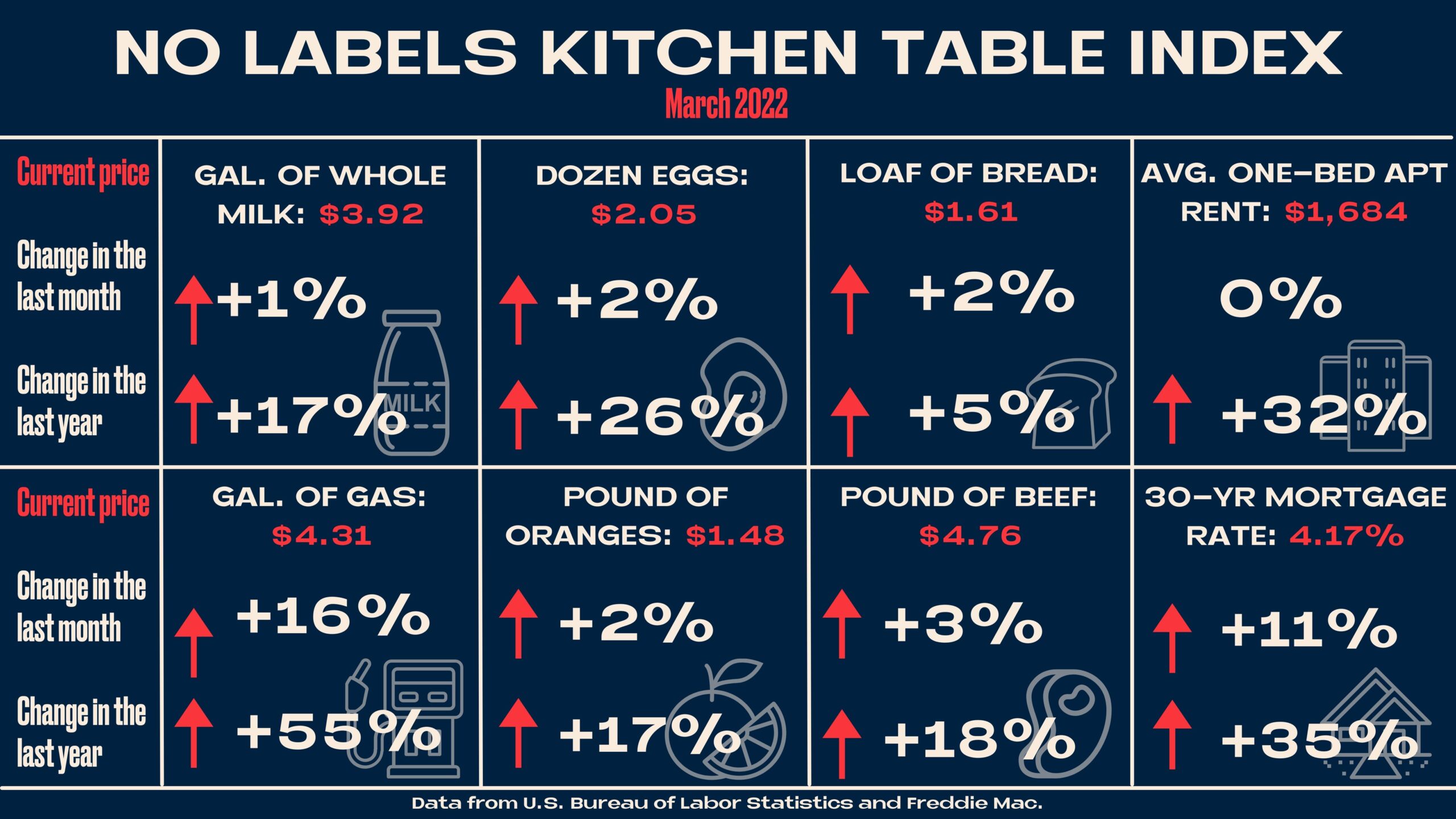
Inflation is at a 40 year high — climbing to an eye-opening 8.5% in March. Inflation is so high, in fact, it’s negating annual wage hikes and salary increases. 

Take note of the price increase chart prepared by No Labels, depicting the specific extent of this increasingly worsening issue:

Some thought the issue was transitory, believing the increases wouldn’t leave a permanent mark on the economy; they were wrong. Writes Sarah Foster, who covers economic policy for Bankrate: “In the aftermath of the coronavirus pandemic, inflation came back with a vengeance. Ensnared in labor shortages and supply chain bottlenecks, price surges were at first only impacting goods that needed to be produced at a manufacturing plant, from used and new vehicles to furniture and appliances. Then, demand for the lockdown-deprived activities of attending a sporting event or concert, as well as traveling, flying or staying in a hotel surged after consumers emerged from lockdowns with stimulus checks and ramped-up savings accounts.

Those increases were all assumed to be temporary, clearing as outbreaks lessened worldwide and post-lockdown demand calmed. So far, however, inflation has only gotten worse — and it’s spread to even more categories, impacting services, rents, meals out at restaurants, repair and delivery services, as well as apparel and food. All of that highlights one of the key fears about inflation: Once it’s taken off on the runway, it’s hard to turn around.”

Hence, it’s a hard problem to solve. 

So let’s try.

Let’s try by setting a couple of prudent ground rules for our leaders. First, level with us. Too many politicians attempt to defer all blame rather than examine how their advocated practices and policy have contributed to the situation. The conflict between Russia and Ukraine is an excellent example. While it has certainly complicated supply issues, rampant inflation began beforehand; too much money was chasing too few goods. So when “Putin Price Hike” is invoked as the new public narrative, that reveals an ulterior motive in the messaging. Friends, I want to solve the problem. I thus crave that our leaders would level with us. Be humble. Be honest. Stop deferring and deflecting.

And second, work together. Find a bipartisan solution. Just as the White House seems actively attempting to defer all blame, let’s also not direct all blame at the White House. Let’s find a way to solve the problem; it’s affecting all of us.

So says a certain sitting senator, one who consistently advocates for bipartisanship. Like him or not, there is wisdom in Sen. Joe Manchin’s words. The Democrat from West Virginia had much to say after the increasingly negative numbers were released on Tuesday:

“When will this end? It is a disservice to the American people to act as if inflation is a new phenomenon. The Federal Reserve and the administration failed to act fast enough, and today’s data is a snapshot in time of the consequences being felt across the country. Instead of acting boldly, our elected leaders and the Federal Reserve continue to respond with half-measures and rhetorical failures searching for where to lay the blame.The American people deserve the truth about why record inflation is happening and what must be done to control it.

Here is the truth: we cannot spend our way to a balanced, healthy economy and continue adding to our $30 trillion national debt. Getting inflation under control will require more aggressive action by a Federal Reserve that waited too long to act. It demands the administration and Congress, Democrats and Republicans alike, support an all-the-above energy policy because that is the only way to bring down the high price of gas and energy while attacking climate change.”

Yes, all emphasis mine.

Let’s stop the blame game. Level with us. Learn to work together. Leaders, your lack of it is hurting us all.

Respectfully…

AR

Ketanji, consent & qualification

Amidst all the news weekly jockeying for our attention, some issues and events understandably attract significantly more. This past week we saw the war in Ukraine heartbreakingly continue… we saw former Pres. Barack Obama return to the White House and the entire room again excited to see a president… we also witnessed the confirmation of another Supreme Court justice. The 51 year-old Ketanji Brown Jackson, a former appeals court judge with nine years experience on the federal bench, was confirmed by the Senate on Thursday.

For years I’ve struggled with how our legislators treat Supreme Court nominees. Something has just seemed off. Let me be a little more blunt. Something has seemed wrong. Disrespectful of people, disrespectful of the process, and wrong.

Part of the difficulty in accurately assessing the wrongdoing is because oh-so-many justify disrespect of the people or process from one side only. That makes no sense to me.

With the confirmation of Jackson — who will serve as the third black justice, the second current black justice alongside Clarence Thomas, and the first black female justice — I heard more acknowledge publicly the lack of integrity long embedded in the process. 

First, from Sen. Dick Durbin, the Illinois Democrat on the Senate floor last week, when addressing the 4 or 5 senators he believed treated Jackson’s nomination inappropriately:

“We’ve done it, too, on the Democratic side. I’m gonna be first to admit, as I look back in history, there are things that should have been handled better when Republican nominees were before us.”

The admissions continued, as Sen. Chris Coons, the Democrat from Delaware, acknowledged in his sit-down interview with PBS this week. He was asked by PBS, “As you think about the current forces that have increasingly polarized the process and your own votes for Trump’s Supreme Court nominees, do you stand by them? Or do you think in a different world you might have thought about those votes differently?”

Said Coons: “I’ve recently been talking about that with some colleagues. So I was — my office now was John McCain’s office — and I think a lot about John. I was in that exact office with a bipartisan group of senators as Judge Gorsuch was being nominated for the Supreme Court, and a group of us were debating whether we could somehow come up with an agreement to not end the filibuster — the 60 vote threshold for justices — in exchange for allowing Gorsuch to move forward. And as I was digging into his record and philosophy, there was one case, the Hobby Lobby case, where he’d written the circuit court, and I just was really struggling with it. I would say Gorsuch was the closest for me where I knew him, I had a sense of him, his writings.”

Back to the interviewer: “But is it about judicial philosophy or advice and consent?” [Note: all emphasis mine.]

Coons: “That’s the point. That was the point at which I first voted against a nominee for the Supreme Court not based on his qualifications; he’s eminently qualified, great temperament, good writer, strong record of service. But I disagreed with his philosophy.

And Senator [Lindsay] Graham and I had a very forceful exchange at that point, where he said to me, ‘I voted for [Justice Elena] Kagan. I voted for [Justice Sonia] Sotomayor. If you’re not willing to vote for Gorsuch, what’s that mean?’

And so I will own that I’m a part of this problem — and recognize that with Senator Graham saying in this [Jackson’s] process — he’s voting against her — he was the last one on the committee who had a history of voting for qualification, not for or against philosophy.”

And therein lies the problem. Being qualified matters less than sharing political philosophy. On the left. On the right. And we only point it out when the other side does it; we make excuses for our own entrenched pathways of political thinking.

One of the wiser, non-politically-motivated voices in Ketanji Brown Jackson’s judicial pursuit came from the former Speaker of the House, Paul Ryan, the Wisconsin Republican. Ryan and Jackson are related by marriage. 

Said Ryan: “Our politics may differ, but my praise for Ketanji’s intellect, for her character, for her integrity, it is unequivocal. She is an amazing person, and I favorably recommend her consideration.”

I wish our politics quit impeding our ability to see who’s qualified.

And amazing. On all sides.

Respectfully…

AR