friends for whom i am an ally

PearlsWhat if…

My friend was born gifted artistically and relationally, different build and interests than his football trophy-winning brothers and father.  He watched from the kitchen window, wanting to be invited into the brotherhood, but their limited scope of relating as males unintentionally and unfortunately created a rift, leaving him on the outside looking in.  Instead of acknowledging his gifts as equally (potentially even more) valuable, masculine strengths in the world, there was a void of male affirmation and bonding.  Finding girls easier to relate to, he was called sissy and other names at school.  Then, eager to be accepted by an older boy, he found himself lured and molested.  Gifted, alone, eager to fit in, rejected, finding solace in friends that were girls, molested… What if… he was given no choice to sort out those feelings as to what they may mean, but only told some of the names he was called were true? “You are gay.”  “You were born that way. Accept it.”

Wait, rewind… how was he born?  Slight of stature, sensitive relationally and talented artistically, gifted differently than any of the males in his family.  Born into an environment with a limited perspective of what it means to be male, no one perceptive to affirm and encourage his gifts as wonderfully valuable in the world of men, calling him into manhood as a respected leader.  His boyhood became shaped by the traumatic and confusing experience of being drawn instead into an abusive sexual experience by someone he’d hoped would be a true friend.

I would never want my friend to change his relational nature.  His gifts are no less masculine in the arts as in athletics. He is a great husband, father, dance instructor, counselor, son, brother, friend.  He has realized that his perceptions of himself and others formed not exclusively because of the way he was born, but like all of us, because of the perspectives and shaping of the relationship dynamics around him, including societal values, others’ imperfect attitudes toward him, and comparison of himself to others, starting in his family.  Experiences (not all ideal) mixed with personal perceptions led to responses in his young life, creating and solidifying his view of self in comparison to other men, some of which were not worthy to emulate. Did that make him less of a man — or was there a bigger problem with our worldly perspective of manhood, and the labeling of those who are not within the popular machismo?

Wouldn’t the world be a better place if people had known to embrace and encourage the more sensitive, creative young men as great models of the measure of a man — and empowered those hearts with courage that they have just what it takes in unique gifts to be the virtuous men and leaders this world needs?  Not “sissy”… not “go play with the girls because you don’t fit here”… Not to be used sexually by a bully.

Where did that all leave my friend in puberty? Quite confused.  More bonded with the girls, still wanting, needing acceptance among his own gender, but labeled as feminized, and then, his strongest experience feeling most “accepted” by a male being a perpetrator’s seduction.

What if…

What goes into determining one is “gay”?  Alongside the popular idea of “born that way,” (the ideology many want accepted as the foregone conclusion of every story),  I’ve heard many personal stories of young men called names, labeled with “fag,” “sissy,” “girl,” etc., before they had any concept of sexuality…  or “tomboy,” “butch,” “dike,” “lesbian,” toward precious, strong girls — many surviving childhood molestation, and/or more subtle exposure to cruelty or porn in the home, its very presence screaming underlying attitudes of what society accepts as the pinnacle pinup model of women — and the expectation of objectification and idolatry as a pleasurable pastime for men.  Female friends of mine share these experiences from their formative years, mixed with broken relationships in homes, and unfortunate combinations of passive and harsh parents, and society says, “Born that way!  Period.”

Is there not cause to speak of the need (& the lack) of protection of innocence and purity over the emotional, spiritual, and yes, even sexual development of children in our world?  How do we respect the strength and value of little boys and girls?  … of teens, young women, and men?  Lacking protection, the cultural messages are loud and clear — rather than affirming the goodness of their gender, instead degrading and polluting it in so many ways.  Degrading them.  All of us!  Would any argue that our culture is wounded and bleeding in many places in the area of sexuality?

The transition from childhood into what it means to be an adult in a highly sexualized culture is fraught with hazard.  And what are we saying if we are allowing the stereotype and labeling to continue, that particularly more relationally sensitive, less athletic, or more artistically gifted males, or physically strong, outdoorsy girls are “born gay”?  I realize that we’re not limiting “gayness” to those who are seen as having softer traits as boys or more athleticism in girls. But if we admit to having in society often correlated, even labeled those qualities as “born that way/gay,” are we potentially part of the development of that self-perception in some individuals?  And, here’s a heated question:  has society called “gay” what was not popularly accepted as healthy qualities for heterosexuality?  Strength in femininity and sensitivity in males? (Are these questions too deep — too sensitive?  I won’t be surprised if they hit some nerves!)

Are we really going to ignore all the factors that go into the development of sexuality — and those experiences that most certainly have a sway on the development of sexual feelings and gender identity?  What if my friends who were labeled this way are given no help, no encouragement, no choice to look at the circumstances of environment, experiences, and nurture part of their sexual development, just because that’s the politically correct accepted belief right now?  What if any sexual abuse and perversion toward gender development is ignored, all for the sake of “accept and embrace any feelings as meaning this different identity over here, and go proudly on!”?  What if what’s “pop” at the moment is not the full picture?  What if that does not touch the deepest heart issues at stake?

Would encouraging these friends to go explore sexual experiences of any kind help?  Would that not be like telling someone with an open wound or a broken bone to go run and play, ignoring their need for care and attention to prevent further pain and danger of infection — or for bones to be set to heal back to full strength and function?  To ignore the existence of factors other than genetic is not the full picture… it’s not love… and it’s not respecting the whole of the individual and choice.

My friends have come to see themselves as adequate men and women.  They came to recognize their first sexual experiences as abusive and not defining.  They are still overcoming perceptions thrust on them now of being “gay but in denial,” from those on one side of the political spectrum — and of “not trying harder to be feminine or masculine enough” (based on societal outward expectations) from some on the other extreme — instead of being looked upon in general as a good and accepted example of heterosexual masculinity or femininity, as the sensitively mannered male, and intelligent, athletic female.  I believe these factors when they tell me, are worth considering.

What if…

Respectfully…

A Friend

what would God have me do?

BikesAs I look back on the 52 years I’ve been at my profession, I have tried to respond to life’s situations asking, “What would God have me do?”  Sometimes that direction has come quickly.  Sometimes it has taken longer.

One night I was called to a home where the husband had shot his wife and then himself, killing both.  Their nine year old son was in the police squad when I arrived.  My direction was to search with the boy for a relative, teacher, friend — anyone with whom he was familiar, who could be with him when I shared the news of what had happened in that house.

Early one evening I was called to a home where a domestic dispute was re-erupting.  I went to the home, knocked on the door and heard, “Come in!”  I entered and observed a man holding a gun on his wife and then stating to me, “As long as I’m going to shoot one I might as well shoot two.”  The direction I felt at that moment was “talk fast.”  And I did.

One day a man, separated from his wife, took his two children to his parent’s house and then went home and killed himself.  I was asked to go with the children’s mother and two police officers to help put the children in the mother’s custody and then tell the parents what their son had done.  We had a plan for approach.  As soon as the grandmother saw her daughter-in-law at the door, everything disrupted.  We all discarded the plan and took care of the children’s safety and informing the grandparents, as seemed best to do.

Then last year around Christmas, I was at the hospital when the oncologist said to me, “Your daughter has stage four cancer.  She is the youngest patient I have ever had with this type of cancer.  I usually find it in 65+ year old men, and I give them a year to live.”  I didn’t have a plan for his one.  “God, what would you have me do?”  Nope, that wasn’t the first question that came.  It was more like, “How can this be?”  And of course, I didn’t believe it.

I had been with parents whose children had become seriously ill many times.  I had been with families whose teen children and younger had lost their life to drugs, accidents, other illnesses.  But this was my own daughter, my own flesh and blood, my own child — my goodness.  “How can this be?”

When such news comes I know there is an emotional process.  But I also know everyone proceeds through that process in their own individual way.  I started with denial.  My wife and I exchanged thoughts, emotions, fears, expressions of our faith and more, giving strength to each other every day.  My extended family, the church and this community have been enormously supportive.

But do you know what has been the most helpful?  It is that 34 year old daughter who has stage four cancer.  She is absolutely amazing.  She sees the good that God has brought forth in so many ways from this situation.  She believes “In all things God works together for good with those who love Him.”  And she does love Him.  She has not missed her work teaching at school except for days I have taken her to the Iowa City Cancer Center for chemotherapy.  She continues to give the children’s sermon in worship once a month.  She gets her eight year old daughter to dance lessons and her six year old son to baseball.  She has a setback for a few days following the chemo, but she endures it with an unbelievable attitude.  Truly this young lady is an extraordinary inspiration to me, her mother, her family, her school, her church and this entire community.

This time when I asked, “What would God have me do?” He answered through Nicole.

Respectfully…

Bob

forgiving self?

When I accepted the invitation to guest blog while a well deserved sabbatical is enjoyed by AR and her family, I once again procrastinated.  Of course, I then beat myself up trying to force myself to figure out a topic on which to write.  And once again, I became one of the last to turn in her work.  I thought to myself, “I sure hope AR forgives me.”  And knowing my sweet sister, AR, I am most positive she does.  The word forgive got me thinking.   I scrapped the beginnings of a post that I had struggled to write and started over.


I forgive you.  I forgive you, but I won’t forget.  Can you ever forgive me?   Please forgive me.  Father, please forgive me.


How many times have we heard or uttered one of those sentences?  I looked up quotes with the word “forgive” in them, and of course, website after website had plenty to choose.  Quotes from famous people, quotes that made sense, quotes that made no sense whatsoever… funny quotes, sad quotes… however, for today I want to focus on these words that I am sure each one of us has thought, said or heard more than once.


“I can’t forgive myself.”  


Culture today perhaps teaches us that in order to move on with our lives we must forgive ourselves.  Indeed a difficult task.  After all, forgiveness is hard work.  The historic scriptures are peppered with the words “forgive,” “forgiveness,” “forgiven”…


Forgive us our trespasses, as we forgive those who trespass against us.  Father, forgive them; they know not what they do.


Doing some very quick research, depending on the translation used, I noted that the word “forgive” in the bible is used at minimum 27 times, but never once does scripture call us to forgive ourselves.  Believe me, I have looked!  I have had many loving conversations gathered around a table, bibles open and not one of us could find a specific verse calling us to forgive ourselves. We are called to forgive and we are called to ask God for forgiveness.  But we are not called to forgive ourselves.  Forgiving our own sin is God’s work. If we forgive ourselves, does that truly free us? … or are we still in bondage to our wrongdoing?  Do we have the power to pardon ourselves?  I read a quote in a devotional that I keep in my bible:  “As the author of Hebrews points out, if our forgiveness relies on our doing something, that forgiveness has no effect at all, outside of creating guilt.”   And so the cycle continues.  The enemy will continue to remind us that we are unforgivable if we cannot forgive ourselves, putting the focus on ourselves rather than the Forgiver.


The forgiveness of the cross eliminated the need for us to forgive ourselves from our wrongdoings.  We can humbly go to God for the work that only God can do in our lives.   So the next time you think or say “I cannot forgive myself for what I have done,” remember you do not need to take on such a lofty task.  Go to the Forgiver, with a true repentant heart. He will forgive your sin and remember it no more.


Respectfully…

KS

under the knife

jl7052At the age of 56, I find myself in counseling. No addictions, no marriage crisis or nights filled with sleeplessness, yet here I am going every other week to someone I hope can extend a handhold up out of the ruts where I currently reside.


A couple of years ago my kids started not so casually mentioning the idea of me seeing someone for my extreme emotional reactions. My frequent hurt feelings and intense crying never seemed over the top to me, but then I was blinded by my oceanic need for affirmation. When I felt rejected by someone, mainly family members, I fell completely apart. Even though I have been in some very stretching accountability relationships over the last 10 years and my personal awareness level is pretty high, I wasn’t able to identify this “growth area” (a nice way of saying weakness or fault).


The other thing that concerned my family was my physical fitness. My parents both led very sedentary lives, which affected their health in significant ways. Everyone wants a different outcome for me.


Like any good person in denial, I put off making that appointment for several years. But after going through two major surgeries to regain some physical health, it occurred to me that shoring up my emotional well being would be a good idea. I adopted a new mantra:  “I want to finish this life well!”


So what does that look like?


I began to take inventory of my resentments. Who am I holding a grudge against and why? God showed up here in an unexpected way by prompting me to ask myself some very difficult questions, like:

“What was I getting out of holding on to this resentment?” 

“What may I not be considering about this situation?” 

“How did I want to experience judgment and forgiveness from others?”


My counselor added more questions to ponder…

“How was I nurtured as a young girl?” 

“What triggers cause me to act like a hysterical child instead of responding as an adult?” 

“Why am I so reactionary?” 

Part of me feels really good about this process of discovery, but the other part of me says it’s too exhausting. I fight feeling defeated.


This lack of confidence carries over into my pursuit of fitness as well. I have a lot of weight to lose. How will I ever achieve this?


I need to envision myself differently. The invisible conversation bubble over my head says, “Busy pursuing fitness!” The other day I actually bought fitness wear. Getting back to the gym is next. It’s difficult to change the DNA of someone who loves reading, writing and knitting, but finishing well means adding movement and energy to my life.


“Wanna to go for a walk?”


Respectfully…

CB

otherness

woman girl on trainFather, Mother, and Me
Sister and Auntie say
All the people like us are We,
And every one else is They.

“We and They” by Rudyard Kipling

I’m on the train going back to Bandung after a day in Jakarta. It’s a nice train – nicer than Amtrak – with a comfortable seating, attentive stewards, and an air conditioner that would rival the blast freezer at any high end restaurant. Families sit and sit together, watching the bad television at the front end of the train, letting their kids run amok. There are a bunch of little kids, and as they run up and down the train – not too loud, oddly – they all stop and stare at me because I’m the only bule around.

It’s odd that primarily when I travel do I feel my otherness. People – mainly kids – peer around corners and over seats to get a glimpse of the lone white guy, as though they haven’t seen one before (and perhaps they haven’t). Usually my neighborhood places in Bandung know me, so I don’t feel as though I stand out much there. It’s just when I travel that I really remember that I’m the only white guy, standing out from the crowd, garnering looks or a few surreptitious camera snaps from a Blackberry under someone’s arm.

The first time I experienced this was about a month after I moved to Indonesia, when I was on the island of Sulawesi (another post on this trip here). What I didn’t go into in the post I just mentioned was my first experience of the bule effect. I was with a friend bringing supplies to a village cut off by a landslide, and a helicopter was picking up boxes of noodles and water to aid the isolated area. I was one of two bule in the vicinity and I felt it. It was palpable. Literally every person in the surrounding area came to see the helicopter landing and taking off multiple times. It was an impressive sight. Apparently, so was I, because when the dust from the helicopter had cleared, the people had not left yet, and they were still snapping pictures with whatever device they had at hand – of me.

The military who came in to supervise the operation was starting to clear the people out when they noticed who they were taking pictures of, and they started to walk toward me. I was a little freaked out because I was not ready for armed soldiers striding in my direction, saying things in a language I did not yet understand.

Frozen, I just stood to see what what about to happen. They got to me and were also speaking quickly in Indonesian, and finally I picked out the words that I would come to associate with traveling in Indonesia: “Foto, Mister?”

With that, no less uncomfortable, but much less fearful, my newfound military friends proceeded to form a line at least thirty deep, each shaking my hand and putting an arm around my shoulder before having one of their compatriots snap a few quick pictures. I’m probably on the Facebook pages of half the military in Sulawesi now, all for the incredible achievement of being different.

It’s no longer an uncomfortable feeling because it is in no way malicious. The most it is is slightly intrusive when someone gawks for too long in an obvious way or asks to take a picture with me. I think that I haven’t done anything to deserve it – I’m certainly no Brad Pitt, and it seems to reinforce the tradition of idolizing foreigners. But at the same time, it’s flattering and kind, and often funny.

After two years, I can tell when they’re going to come over to ask for the picture. By now, I’m pretty good at sensing it. There’s a posse – usually girls – who slowly and not-so-nonchalantly makes its way toward me. They usually are whispering to one another, shooting furtive glances my way, each one coaxing the others to make the first step to asking for a picture. Or odder still, an “interview.”

The interview is an interesting phenomenon because it’s a completely legitimate tool that the universities use to have their students practice their English. They’ll send out groups to talk to unsuspecting bule sitting in coffee shops (usually grading or working on lesson plans, in my case), and they’ll descend on us – often with the same modus operandi as the picture seekers. These interviewers can be divided into two categories: real and fake. The legitimate ones have a set of questions printed on a piece of paper that they follow and on which they record my answers. The fakers all very clearly make it up as they go, writing nothing, but plowing ahead boldly anyway, and I don’t have the heart to completely shut them down. However, after a few minutes they run out of steam and fade out, while those with the questionnaires follow their script, and I’m usually happy to let them proceed – I am a teacher after all.

The questions, legitimate or otherwise, always follow the same script.

1. What is your name?
2. Where are you from? (About half the time, when I answer that I’m American, they’ll respond with a thumbs up and a hearty “Obama!”)
3. How long have you been in Indonesia?
4. What are you doing here? Student or teacher?

This is all standard fare, but then the inevitable final question:

5. What is the biggest difference between America and Indonesia?

My answer to that question: That question.

At no point in America – if you value your safety or dignity – would someone go up to another person and, based solely upon the premise of their otherness, begin interrogating that person. Certainly not, “Hey, you’re Black/Asian/Hispanic/Insert Ethnicity Here: Answer my questions!” Your answer might come in the form of a punch in the nose.

We’re perfectly accustomed to our heterogeneous lives. Differences are a part of our DNA in the United States – obviously there are those who feel differently, who harbor a deep seated racism. But, walk through any supermarket, not to mention a Whole Foods or something like Jungle Jim’s (a regional tourist destination in the Midwest), and you’ll see evidence that we like difference. Everything we have and everything we are came from another place.

The situation in which I often find myself simply speaks to the homogeneity paradox of Indonesia. At least, in terms of Asian to non-Asian. This is actually a hugely diverse nation. With countless tribal groups (of which I’ve only encountered a scant few), and a large, fairly dominant (in terms of economics) Chinese population, there is nothing but diversity in Indonesia. They have an aspect of their constitution that says, Bhinneka Tunggal Ika, similar to our E Pluribus Unum. However, here there is a minuscule minority of caucasians. Hence, the stares, pictures, and other efforts to single us out. Once I was walking by a school while students were eating lunch, and a group of ten high schoolers ran to the fence and clung to it, wide-eyed and open-mouthed, watching me walk by. I’m not narcissistic, either. I was the only person within sight walking down the road near my house. It’s just an odd fact of life.

I’m not annoyed by it, unless I am actually trying to get work done at the coffee shop, and even then I tell the interviewers that I only have a few minutes to spare and they readily oblige. I worry at times that these moments reinforce the decades – centuries even – old perception of westerners as better or more important than Indonesians, a thought process instilled by the Dutch during their occupation. This imperialistic holdover bothers me. Edward Said would have found some irony, however, as generally he talked about Otherness in context of those in Power marginalizing those without it by thinking of them as set apart and below themselves. The stereotype that stems from the colonial period is that of the European superiority, infused in the culture on many levels. And yet, I am a schoolteacher in Asia who is singled out by those around him, questioned and viewed as exotic. Oh, how the tables have turned, Mr. Said.

And then other times I think that it’s just because I represent a culture that (for better or worse) they’re focused on, through movies and music. They rarely see white people outside of that context, and so they take the opportunity as some would when they see someone famous, because it’s simply outside the realm of normality. So maybe it isn’t so different from Said’s premise, after all.

But most often it’s just the picture. We all smile awkwardly – which everyone knows it is – and take the picture(s). About half the time the whole group takes the picture together, and the rest of the time is a long series of one at a time pictures, just me and a long string of girls. It’s weirder when there’s the random couple of guys in the midst of the girls, because let’s face it: I’d rather have pictures with girls I don’t know than guys.

I hope that when they meet me they realize that there’s nothing special or picture worthy about me. I’m just different, and my kind of different is simply in the form of my skin. Regardless, I’ll still be there, sitting at the coffee shop, probably grading or writing lesson plans, and I’m happy to talk for awhile, though it will be less illuminating than they think.

Respectfully…

Tyler

the impact of personalized news sources

medijsko_sredisceOne of the things I enjoy about living in 21st century America where we have relative economic prosperity and technological innovation are all the choices available to me.

When I was a kid, we’d go to McDonald’s, and I could choose between the Big Mac, the Quarter Pounder, and the Filet-O-Fish.  That was it.  Today my options at the Golden Arches include hamburgers with all sorts of toppings such as bacon habanero ranch, chicken (grilled, crispy, or even nuggets), a McRib, wraps, salads, yogurt, not to mention multiple latte and smoothie flavors.

Of course, Mickey D’s isn’t the only fast food restaurant in town any more, and now I can go to Subway, Qdoba, Jack-in-the-Box, Jimmy John’s, Chick-fil-A, Culver’s, Five Guys, Noodles & Company, or Rally’s, none of which were around when I was young.

Henry Ford famously said you can have any color Model T you want, as long as it’s black.  Today, your local car dealer can offer you shades of Smoky Topaz, Techno Pink, Lemonade Yellow, or Jalapeno Green.  (I did not make any of those up!)  There are plenty more product examples I could provide, but you get the picture.

Where I am going with this is that as I was growing up, our news came primarily from either ABC, CBS, or NBC, period.  Now there’s Fox, CNN, and MSNBC on cable TV, plus a plethora of Internet sites too many to list.  Overall, I think having more choices is better, but in this instance there is a downside.

Because these multiple news sources have a smaller share of the overall market than the big three networks from forty years ago, each of them are able to tailor their news toward the preferences of their audience.  Even if they’re not editorializing, opinions still come out in how stories are presented.  Further bias is demonstrated through what current events are covered (as well as what events are not covered).

Someone who gets their news from the Drudge Report, Breitbart, and the Gateway Pundit will get a totally different view of the world from their neighbor who frequents the Huffington Post, Salon, and Daily Kos.  Those two people could check the news the same morning and end up thinking very different things happened the day before.

I consider myself a political junkie; however, I no longer enjoy engaging in political debates.  So often when I talk with someone from the opposite side of the ideological spectrum, we just end up shouting past each other.  It’s fun and intellectually stimulating to explore differing philosophies and understand why others come to opposing conclusions.  It’s boring and uninteresting argue about what the facts are, and that’s what our political discourse seems to amount to today.

This situation isn’t going to reverse course anytime soon.  In fact I would predict even more customization of our news.  What’s to stop right-leaning news sources from dividing into (for lack of a better term) Tea Party and Establishment news channels?  The left might separate into liberal and full-fledged progressive information sites.

Andy Warhol said that in the future, everyone will be famous for fifteen minutes.  I say, in the future, everyone will have their own personal news source.  And it won’t be pretty.

Respectfully…

Pete

connected

1385104_10203286569822360_1244629544_nSo many issues we face in this modern world: I’ve heard it said recently that things aren’t really any worse than they’ve ever been; we just have the technology to know immediately when trouble arises. I don’t know if that’s true, but I do know that we are in a constant state of being connected. But the reality of that is, while the ability to obtain knowledge and communicate with people is always at our fingertips, we as a society as a whole are far less authentically connected than we have ever been.

The truth of the matter is, no matter how many Facebook friends, followers and likes you have on social media, nothing trumps authentic one-on-one communication. Nothing tops spending real time with people.  Not only is it good for your soul, it teaches you about humanity.  How to accept people for all their parts, to see the world through a different perspective, that everyone has something to contribute, how to have a debate when you don’t agree, see expression on their faces, passion in their voices. Know them, truly.

And you can’t get that from any device you can hold in your hand.

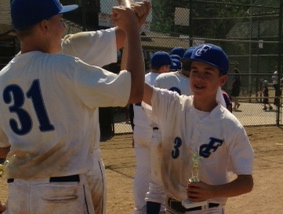
You have to have connection — real human connection.  To make friends out of strangers. I was reminded of that last night at my son’s baseball banquet.  Here was a group of 16 boys different ages and grades. Some have played together for years, some have for a few seasons, and some had never played together. But from the start, they have made an effort to get to know one another. Establish a bond. And when the captain, a senior, stood up to give his senior speech, he really made the point clear — you can’t be a team if you don’t have a connection and you can’t have that without spending time together.  Baseball more than any sport is about chemistry. So, when the season started, when they were getting the cobwebs out of their batting mechanics, awakening the muscles used to field a ground ball or the throw from right field to third base, just as important, was building the bond of a team. And seeing those boys together last night, it was more than obvious that is what they are, and more than that, they are friends.

And as this season continues, and it has been a successful one on the field, I think the memories those boys will carry is the fun they had with each other off the field, that so contributed to the success they have had on the field. And they did it through cookouts, and bonfires. Through team lunches, and fishing excursions. They did it by getting to know each other, and the giving and earning of respect.

In person.  Being present in the moments that they will have as memories for all their lives.  They put down their phones and their video games. They didn’t really even post or tweet about any of it. They were too busy living it.

What an example for all of us. How many times a day do you look at your phone?  When you are meeting a friend for lunch how many times do you check your phone?  Send a text? Answer a call? What in your present are you missing by being so plugged in?  Authentic one-on-one communication, it is the greatest way we have to really understand each other. Support each other; learn to respect each other’s differences.

So for me, I’m going to take a cue from my son, and his team. I am going to stop being tied to that tiny screen. Make some authentic plans with people I love and people I want to get to know better.  Maybe if we all did, if we stopped working so hard at being connected, and made actual human connections, we’d all feel more a part of our communities, and society as a whole.  A part of the team.  And if I’ve learned anything this season:  a well-connected team is one that wins.  When that happens, it gives us all something to celebrate.

Respectfully…

Jules

guest writer series

4263193267_fb5cee0c57_z‘Tis time to reflect upon why we do what we do — on the purpose of the infamous Intramuralist.

Contrary to the blogs of many, my goal has never been to make you think like me.  Sorry, but I have news for you:  there are places where I’m wrong; there are places where my perspective is unknowingly limited; there are places where my perspective is not so limited and I’m still wrong.  There are also places where my reasoning is wrong and I have no idea.

Hence, the purpose of this blog is not to encourage likeminded thinking.  In fact, that approach by many of our elect and supporting activists disturbs me.  This country has never focused on likemindedness.  Wisdom has never equated to the robotic toeing of an ideological line.

The purpose of our posting has always been to model respectful dialogue.  That means stating our opinion in such a way that it’s respectful to all — even and especially to the one who disagrees with us.  The subsequent goal is to encourage dialogue — and then really listen, — because (1) listening is a basic form of respect, and (2) we craft solution from respectful dialogue.  Friends, one thing all leaders need to learn is that they do not solve an issue by shutting an opponent down.  Such is merely a foolish escape deliberately guised by the intelligent, albeit not the wise.

Thus, a primary belief I have always adhered to is that we’re in this together.  As recently written, we are “doing life” together; therefore, we grow.  While three days a week, I pick up my figurative pen and promptly post a semi-humble sentiment, it is my sense that we are in this together.

As evidence of such, on Tuesday we begin one of my favorite, summer activities.  It’s time for our 6th annual Intramuralist Guest Writers Series!  For half a dozen years now, we have featured the writings and perspectives of a wide variety of people — people I know… people I deeply respect… people who may or may not think like me.  Thinking like me doesn’t matter.

We will hear from thirteen creative, expressive individuals who have agreed to model our respectful mantra over the next four weeks.  Their topics of choice are diverse.  From a writer to a state senator to a food bank director… from a retired teacher to a current teacher to a young man living overseas… from a college kid to a stay-at-home mom to a career pastor… from a psychologist to nonprofit director to a realtor and wise  new grandma… We have a creative, articulate, passionate group of writers sharing wit and wisdom, strength and sorrow, learnings and leanings, and all sorts of other wise nuggets in between.

Let me state one aspect to be clear:  the Intramuralist may or may not agree with the opinions expressed; that’s not the point.  The point is that each of these admired men and women desire to share their thoughts with you in a respectful way.  At times you will undoubtedly jump out of your seat and cheer along.  You may ‘amen.’  Other days you may grimace.  You might share in their triumph or gasp in their heartache.  But along the way, you will witness respectful, encouraged dialogue.

So join me for this excellent series.  I promise two things:  one, it will be good; and two, I will be back.

Respectfully…

AR

life together

12458_10204397800406760_2323747440649054753_nEvery now and then I have a piece penned and ready to post and an event arises that trumps what was previously planned.  Today is one of those days.

I had this great, insightful blog — noting the commonality between the most pressing current events — and how they magnify the failure of man in recognizing that boundaries are good.  Then something more significant happened in my household.  Something trumped that post.  Something affected my heart so much more…

While seemingly small in comparison to any international incident, yesterday I watched my oldest son say goodbye to one of his best friends…

Jake and Seth have been friends as long as I can remember — no doubt as long as they can remember.  I can’t remember a time when these two weren’t hanging out together.  From their earliest days, they attended the same Sunday school classes — sometimes even paying attention.  🙂

They did school together, baseball together… they’ve done life together.  Together with four other wonderful young men, they became each other’s support.  They were each other’s “group.”  They were each other’s guys.  During those tricky adolescent years when some teens talk lesser to their parents, Jake and Seth were still always talking to each other.  They grew up together.

They’ve laughed together, cried together, gotten in trouble together… eaten together… eaten a lot together… shared stories and girls and loves and heartaches.  They’ve shared ambition — and ambition lost.  They’ve shared dreams and faith and their honest hopes for the future.

They’ve gotten mad at each other.  They’ve hurt each other.  They’ve also been quick to forgive.  They have loved each other well.

As you read this post, Seth will have begun an exciting new journey in his life.  He and his family are literally traveling half way around the world, where his father will be working for the next three years.  There is so much to look forward to; there is also much they leave behind — one of many being their great “group.”  Thanks, no less, to the advances of social media, the boys will still tweet, talk, and text; they will be in touch; it just won’t be the same.  So yesterday Seth came to say goodbye.

How do 17 year old boys who love each other say goodbye?

First they grab the Nerf guns.

Then they play swords.

Then they play baseball on the XBOX.

They gab the entire time.

They laugh and joke and even yell at the players on the XBOX.

They tease and smile and cheer each other on.

They sometimes even share a serious thought.  Then they go back to yelling at the players on the XBOX.

They’re “doing life” together — one last time — at least for now.

I cried yesterday.  Something significant happened in my household.  What a beautiful thing.

Respectfully…

AR

2 strikes

photoAs our youth baseball schedule wraps up for another year, I am again reminded of how God teaches me through the ordinary.  I used to think the God of the universe utilized some cleverly, divine two by fours; then I realized the ordinary is so much more effective…

We were sitting in the stands, eagerly awaiting a come-from-behind rally, under the lights of the small D1 school.  It was a special moment for those undaunted, 15 year old boys.

Truthfully, the game had become somewhat emotional by this point, especially for the adults, soaking in the sentiment of previous innings.  In a split second swing at an earlier fastball, one of our players’ cleats remained firmly lodged in the artificial turf;  his right knee cap was then immediately dis-lodged.  With the instant, accompanying cries of pain and panic, it was a gruesome sight… especially when you love the kid.  Thus, we were waiting for something good.

With a man on and the rally ready, our non-fiction version of Speedy Gonzalez stepped up to the plate.  The young man is a joy to watch, as a hard hit combined with his uncommon quickness often leads to an exciting play.  The moment was undoubtedly intensifying.

“Strike,” the umpire subtly motioned on the first pitch thrown.

We eagerly awaited…  and then…

“Strike three!  You’re out!” yelled the ump in a far more emphatic fashion.  However, “strike three” was called on strike number two.

In the questioning that immediately quieted the crowd, neither team’s supporters knew how to respond…  “Really?  Did he really just call the boy out on only two strikes?”

Fairly respectful clamors clang from the crowd, attempting to respectfully alert the umpire of his obvious error.  The coaches also joined in the questioning, perhaps wondering if there was some kind of “new math” that had yet to be announced.  The ump motioned to our coach to hold off — stay where he was; he would confer with his likeminded peer on the field to discuss what happened.

For an odd, a little-too-long, hushed moment, the two umpires huddled on the field.  It was obvious neither had a ball/strike clicker — and that neither truly knew the count.  After the brief conference, the home plate umpire raised his clenched fist in the air and again signaled “out.”

At that point our coach stepped onto the field, and yelled, “What?  It’s only two strikes,” to which the field umpire promptly yelled more loudly back for our coach to get back in the dugout, as “the decision has been made.”

So here in front of teens who tend to take in all of our adult behavior were two men who had made a obvious mistake, discussed only with the likeminded, and when confronted with the facts, simply shouted for all opposition to shut up.  They refused to dialogue; they refused help from both partial and impartial influence; they refused to acknowledge they even needed help; they instead focused most on silencing refuting fact.

Sometimes we teach our children well.  Sometimes we don’t.  They will learn from both our successes and mistakes… even from the ordinary.

Respectfully…

AR